2008 World Patent Report

The World Intellectual Property Organization has released its 2008 World Patent Report. The 72-page report provides a statistical overview of worldwide patent activity, including the number of patent filings, granted patents, patent families, patents in force, patents by field of technology and the cost of patenting.

Posted in Patent statistics, WIPO | Leave a comment

Proofreading Patents May Save Big $$$

The USPTO published more than 480,000 patent documents in 2007, so it isn’t surprising that a few of them contain errors. Last year the PTO issued 23,000 certificates of correction (CCs), or about 12.5% of all issued patents. CCs are issued to correct typographical errors and other minor defects. However, a recent article citing a study published in the India Business Law Journal suggests that the number of defective patents is much, much higher and that uncorrected errors can be an expensive headache for patent owners. Unfortunately, CCs are not searchable in the USPTO website, although the scanned CC is appended to the original patent. CCs are also announced in the USPTO’s Official Gazette.

Posted in Certificates of Correction, Official Gazette, USPTO | Leave a comment

Inventor’s Last Wish: Bury me in my invention.


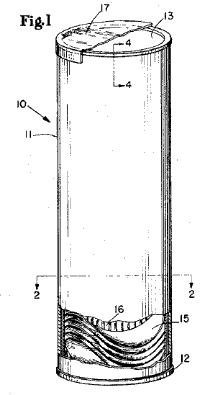
WIPO Magazine reports about the final wish of inventor Frederic Baur, a food chemist for Procter and Gamble. In 1966 Baur applied for a patent on a container for Pringles potato chips (US348798). Baur died in May at the age of 89 and requested that his body be cremated and his ashes buried in a Pringles can. I wonder if it was regular or Ranch flavoured?

Posted in Pringles, Procter and Gamble | Leave a comment

Youngest Patent Holder?


The current issue of WIPO Magazine features a story about a boy who may be the world’s youngest patent holder. Samuel Thomas Houghton of Buxton, UK was only three years old when he had an idea for an improved broom. His father, a patent attorney, applied for a GB patent, which was granted on April 2, 2008 (GB2438091).

It’s impossible to know for sure if little Sammy is the world’s youngest inventor since the inventor’s age is not usually stated in patent applications. But I can think of at least one other very young patent holder from Minnesota. Steven Olson of St. Paul, MN, also the son of a patent attorney, was granted a patent in 2002 for a new “method of swinging on a swing” (US6368227). I believe that little Stevie was only 4 or 5 when his father applied for his patent. His patent is often cited by critics of the USPTO as an example of a low quality patent that should never have been issued. It does look like a vanity project, given that it’s hard to imagine how one would go about commercializing such an invention. I guess it’s no surprise that he let it expire in 2006.

Posted in Children inventors | 1 Comment

Using RF to Treat Cancer

Last night Sixty Minutes did an interesting story on an inventor named John Kanzius who has developed a new radiofrequency therapy to treat tumors and cancerous cells. Kanzius, who has no technical or medical training, was inspired to invent by his fight with leukemia, a disease which still threatens to take his life. Kanzius has at least five US patent applications under review: 20050251233, 20050251234, 20050273143, 20060190063, and 20070250139. His earliest provisional application was filed on May 7, 2004. He also has two published EP applications and two PCT applications.

The treatment involves injecting a tumor with gold nanoparticles and exposing them to RF, which causes the cancerous cells to heat up and die. Adjacent cells are not harmed. The therapy has shown encouraging results in the lab, much to the amazement and delight of canceer researchers.

It just so happens that I am currently reading Margaret Cheney’s excellent 1981 biography of Nikola Tesla, Tesla, Man Out of Time. Tesla was an early pioneer of wireless communication in the 1880s and 1890s and believed in the possibility of wireless transmission of electricity. He also speculated that radiofrequency waves might be used to treat human disease, although he never followed up on the idea. I think it’s fascinating that more than one hundred years later someone might actually fulfill Tesla’s vision.

Posted in cancer, John Kanzius, Nikola Tesla | Leave a comment

Transparency in the US Patent System


An op-ed piece in the July 14th Wall Street Journal by L. Gordon Crovitz makes an interesting case about the shortcomings of the US patent system and the recent failure of Congress to enact patent reform. One of his criticisms is the lack of transparency in the system. This may seem odd given the amount of patent information that is available in public databases. Surely the public has never had better access to the latest patent information? Well, actually…

Although the USPTO was a leader among patent offices in publishing patent data on the web in the mid-1990s, over the past decade it hasn’t invested much in its core patent databases, PatFT and AppFT. PatFT contains issued patents from 1790 to the present and AppFT contains published applications from 2001 forward. Creating a separate database for published applications may have made sense from an internal bureaucratic, ah…administrative, point of view, but it’s a huge disadvantage to searchers because it forces them to do double the work. Almost every type of patent search, from a patentability search to a state-of-the-art search, must include both issued patents and published applications. Other third-party public databases such as esp@cenet, FreePatentsOnline and Patent Lens, allow users to search both types of documents at the same time.

Most patent offices publish patent documents in PDF format, but the USPTO still insists on using TIFF, an obscure format that is loathed by searchers because it requires them to install a special browser plugin such as AlternaTIFF or InterTIFF. And the USPTO still does not allow printing or saving multipage documents, forcing users to go to esp@cenet, which enabled multi-page downloads in 2004, or a third-party service like Pat2PDF, in order to download complete US documents. The USPTO allows does not allow exporting patent bibliographic data, which would be very useful for creating databases or spreadsheets for analysis purposes.

One of the biggest impediments to transparency is the fact that there is no central access point on the USPTO website to patent information. Patent documents, classification, status information, ownership, and post-grant actions are scattered in at least a half dozen systems and channels. For example, the USPTO publishes notices about expired patents, corrections, reexamination filings, reissue applications in the electronic Official Gazette, a weekly periodical that was first published (in print) in 1872. Even though the print edition was discontinued in favor of the electronic in 2002, the format of these notices has not really changed in more than fifty years. Although the OG is searchable back to 1995, it would be much more convenient to make this data available in the PatFT database and allow users to create RSS or e-mail alerts for individual patents. Users who want to check on the ownership status of a patent or published application must use the Assignments on the Web database. Users who want to view the contents of a file wrapper must use the PAIR system. Neither system is connected to the PatFT or AppFT databases.

So while the public has much better access to US patent information than it did 15 years ago, it is still very difficult to find given that it is locked up in so many different silos and stovepipes on the USPTO website. The end result is a very fragmented, user-unfriendly system that effectively hides important information.

Posted in Patent databases, patent information dissemination, Patent reform, USPTO | 2 Comments

Classification Order 1878 – Class 16, Misc. Hardware and Class 52, Buildings

The USPTO has issued a new classification order, #1878, covering changes to Classes 16, Miscellaneous Hardware, and 52, Static Structures (Buildings). Static structures include all types of constructions ranging from amusement park rides and sports stadiums to wind turbines and gravestones. The principal changes in Class 52 affect subclasses related to beams, columns, girders, shafts, reinforcing bars and rods. As of July 1, there are approximately 92,500 patents and 10,600 published applications classified in Class 52.

Posted in classification orders, USPTO | Leave a comment

Medical Innovators: Michael E. Debakey

Dr. Michael DeBakey, a heart surgeon who invented dozens of medical procedures, devices and instruments, died this weekend at age 99 after a extremely long and productive career. (He continued practicing medicine well into his 90s.) While in medical school in the 1930s, he devised a device called a roller pump that eventually would become a core technology in heart-lung machines. Although Dr. Debakey is recognized for many innovations, he only patented a few inventions, including a rotary blood pump in 1999. (US5947892)

Other American medical innovators include Dr. John Gibbon, inventor of the heart-lung machine (US2,702,035) and Forrest M. Bird, inventor of the first low-cost medical respirator in the world. (US3,068,856)

Patenting medical procedures and devices is controversial. Some countries, such as Canada, ban patents for medical therapies. In the 1950s, the American Medical Association lobbied to extend patent protection to medical treatments but as recently as 1995, it condemned doctors who sought to patent certain medical procedures.

Posted in doctors, ethics, medical devices | Leave a comment

Researchers See Patent Quality in Rising Citation Counts

Joff Wild, a journalist and blogger for Intellectual Asset Management Magazine, makes some interesting observations about a new study that claims that the quality of patents issued by the USPTO is rising. The research found, among other things, significant growth in prior art citations in issued patents over the last five years: 41 percent more US patent docs, 36 percent more foreign patent docs and 23 percent more non-patent literature. Wild points out that this research contradicts claims that US patent examiners frequently miss relevant prior art and issue low-quality patents. The research was published in the June issue of Les Nouvelles, the official publication of the Licensing Executives Society (LES).

Posted in patent quality, Patent references, USPTO | Leave a comment

U.S. Patent Counts, Q2 2008

The USPTO published 77,691 patent applications (A docs) in Q2, a six percent increase over the same quarter last year and the second straight quarter over 77,000, but a slight decline from the Q1 2008. The USPTO is on track to publish over 310,000 applications this year. Approximately 1.8 million plant and utilty patent applications have been published since 2001.

The number of issued patents (B docs) rebounded from 43,657 in Q1 to 49,353 in Q2, a dramatic 13 percent jump and a six percent increase over the previous year. Curiously, the number of issued patents remained flat for most of Q2.

Table 1. Quaterly Patent and PGPub Counts*

Qn ….. Patents …..PGPubs ….. Total
Q1 ….. 43,657 ….. 77,962 ….. 121,619
Q1 ….. 49,353 ….. 77,691 ….. 127,044

*Based on preliminary weekly data from the USPTO website. Totals may change after the fact due to withdrawn patents and published applications.

Table 2. Weekly Averages and Medians (Q2)

Patents ….. 3,796 ….. 3,841
PGPubs ….. 5,976 ….. 6,231

Table 3. Number Ranges for 2008 (Totals)

Patents ….. 7,313,829 – 7,392,547 (78,309)
Reissues ….. RE39,964 – RE40,405 (441)
PGPubs ….. 2008/0000001 – 2008/0155725 (155,725)
Designs ….. D558,426 – D571,975 (13,530)
Plants ….. PP18,373 – PP18,990 (618)
SIRs ….. H2,208 – H2,218 (11)

Posted in Uncategorized | Leave a comment