Nortel’s Patent Plum

Nortel Networks, one of Canada’s leading telecommunication technology companies during the 20th century, is bankrupt and in the process of selling off its assets, including its hefty portfolio of thousands of patents and other intellectual property. This week a high profile spat broke out between two rival bidders, Research in Motion, maker of the BlackBerry, and mobile phone giant Ericsson. Nationalism is partly to blame (RIM is a Canadian company) but also at issue is the fate of Nortel’s patents. RIM is keen get Nortel’s patents related to wireless LTE technology.

By rough count, Nortel’s patent portfolio includes more than 3,500 granted U.S. patents, some 760 published patent applications, and approximately 1,000 Canadian patents and pending applications. Thousands more were granted under its former name, Northern Electric Co., which it officially changed in the early 1990s. This is probably one of the largest patent firesales in history.
Posted in Ericsson, Nortel, Research in Motion | 1 Comment

Class 310 Reorganized

The USPTO has reorganized Class 310: Electrical Generator or Motor Structure. Details are provided in Classification Order #1887. Class 310, which was created in 1953, is a bit atypical in that it is a residual class intended to cover technology related to electrical generator or motor structure not classified elsewhere. Which means that searchers may need to consult other related electrical and mechanical classes.

There are currently about 65,000 patents and 13,000 published applications classified in Class 310.

Posted in classification orders | Leave a comment

One Giant Step for Mankind? Moon Ads?

While the world celebrates the 40th anniversary of the first manned-mission to the moon, an entrepreneur in Utah wants to patent a system for creating ads on the moon.

David Jones, owner of Moon Publicity of West Valley City, Utah, has filed a U.S. provisional application for “Shadow Shaping,” a system that uses robotic vehicles to carve product names, logos and web URLs into the surface of the moon. The serial number of the application is 61/150,054, which means that it was probably filed in October or November of 2008. Jones has one year to file a regular patent application based on his provisional. Provisional applications are not published, so it may be more than a year before the world gets to see the details of his invention.

Inventions relating to advertising are generally classified in Class 40, Card, Picture or Sign Exhibiting. This includes skywriting and ground advertisements designed to be seen from aircraft.

Posted in Advertising | 1 Comment

Patent Models on Display at Harvard

Harvard University’s Science Center has a new exhibit of 19th century American patent models. The exhibit, which is called “Patent Republic,” is on display until December and features about 75 patent models from the collection of Susan M. E. Glendening, a New York collector.

From 1836 to 1880, The U.S. Patent Office required inventors to submit a model of their inventions with their patent applications. The models were kept on public display at the Patent Office and became a popular tourist attraction. By the 1870s, however, maintaining the collection, which had grown to hundreds of thousands of models, became a serious burden on the office. Some 87,000 models were destroyed by fire in 1877. In the 1890s, the Patent Office began placing models in storage and eventually the office disposed of the collection, with several thousand models going to the Smithsonian Institution and the families of inventors. The rest were sold or discarded.

Patent models were required in other countries during the 19th century, but most had abandoned the practice by 1900. In Canada, patent models were no longer required after 1892, although the Commissioner of Patents reserved the right to request a model. Some countries continued to require models for certain types of inventions. Germany, for example, required models for firearms and skates and Switzerland required models for firearms and watch movements.

Patent models are highly prized by some collectors. In 1979, Cliff Petersen, a retired engineer, bought about 35,000 models with the intent of establishing a museum. In addition to the Glendening collection, other privately-owned patent model collections include the Rothschild Petersen Patent Model Museum, which contains some 4,000 models obtained from the Petersen estate.

See also “Patent Models Strange Odyssey” by Theresa Riordan, New York Times, Feb. 18, 2002.

Posted in Patent models | 2 Comments

Patent Statistics and Economic Development: Pros and Cons

Patent attorney Stephen Nipper and fellow blogger Chris Blanchard make some interesting comments on the use and misuse of patent statistics as measures of economic development and technological innovation. Both point to the case of Idaho, which in recent years has been ranked #1 in patents per capita thanks to the presence of Micron and HP, two patent powerhouses, in Boise.

I agree that patent statistics, like most statistical measures, can be misleading. In Canada, for example, tiny Yukon, pop. 31,000, ranks #1 in patents per capita, compared to the more populous and industralized provinces of Alberta (3.2 million), Ontario (12.5 million) and Quebec (7.5 million). Blanchard argues that patent statistical outliers like Yukon should be omitted or at least accounted for in economic development studies.

Nipper and Blanchard’s criticism is a valid one, but I think it’s wrong to completely dismiss patents as a useful (but indirect) measure of economic development. A large number of patents issued to a particular region or city might suggest a large population of highly educated engineers or successful independent inventors. For example, inventor Solly Angel, author of The Tale of the Scale, used patent statistics to decide what city might offer the best support network for a first-time inventor. He settled on New York because of its high concentration of patent attorneys, inventors, consulting engineers and suppliers.

Most patent offices publish annual patent statistics. The USPTO also publishes numerous reports on patent activity by organization, technology and geographic area. The WIPO collects and publishes patent statistics from around the world.

Posted in Patent statistics | 1 Comment

US Patent Counts, Q2 2009

The USPTO issued 48,596 patents in Q2, down slightly from 2008, and published 81,288 applications, 4.6 percent more than the same period last year. Approximately 2.1 million plant and utility patent applications have been published since 2001. The USPTO is on track to publish more than 330,000 applications in 2009, which would be the largest total on record.

Plant patent no. PP20,000 was issued on May 19, 2009 for a new and distinct type of Cuphea plant, a type of flowering shrub. The inventor is Christiaan Unger of Worms, Germany, who is credited with three other plant patents. Design patent no. 600,000 is expected in October. Only two statutory invention registrations have been registered this year, which suggests that their popularity is waning. SIRs are, for all intents and purposes, simply published applications. They may be cited as prior art but carry no patent rights.

Table 1. Quarterly Patent and PGPub Counts*

2009 ….. Patents (B) …..PGPubs (A)….. Total (A + B)
Q1 ….. 49,227 ….. 83,855 ….. 133,112
Q2 ….. 48,596 ….. 81,288 ….. 129,884

*Based on preliminary weekly data from the USPTO website. Totals may change after the fact due to withdrawn patents and published applications.

Table 2. Weekly Averages and Medians (Q2)

Patents ….. 3,738 ….. 3,764
PGPubs ….. 6,253 ….. 6,228

Table 3. Number Ranges for 2009, Jan. 1 – June 30

Utility patents ….. 7,472,428 – 7,555,787
Reissues ….. RE40,613 – RE40,817
PGPubs ….. 2009/0000001 – 2009/0183289
Designs ….. D584,026 – D595,475
Plants …… PP19,613 – PP20,148
SIRs ….. H2,228 – H2,229

Posted in Patent statistics, USPTO | Leave a comment

Inventor of Magic Fingers Vibrating Bed, 1916-2009

The inventor of the Magic Fingers Vibrating Bed, John Houghtaling, died last week at the age of 92. Houghtaling patented his invention in 1962 (US 3,035,572), and founded Magic Fingers, Inc. to commercialize it. His company installed millions of units in hotel and motel rooms across America in the 1960s and 70s.

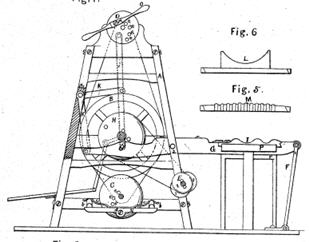
Houghtaling wasn’t the first inventor to conceive of a mechanical device to relieve weary or weak muscles. In 1869, Allen L. Wood of New York City, patented an “apparatus for treating diseases” (US 97,944) that consisted “of certain mechanisms, whereby circular or rotary motion… is made to perform several operations of rubbing, kneading, and giving vibratory and other action to muscles and various parts of the system.” Wood’s device (see below) looks more like a medieval torture rack designed to extract confessions than heal the sick.

Other similar devices are found in USPC Class 601, Surgery: Kinesitherapy, subclass 40+.

Posted in Houghtaling, inventors, Magic Fingers | 1 Comment

AusPat v1.3 Enhancements

IP Australia has announced the release of AusPat v1.3, the new web-based Australian patent database that replaced the PatSearch system in early 2008. AusPat v1.3 enhancements include (quoting from the release memo):

  1. “e-Journal functionality has been incorporated into AusPat with the introduction of a new search field (called “Publication”) allowing users to search by Publication Action and Journal* Range.
  2. The “Acceptance Published Date” search field has been removed. To search for applications by Acceptance Published Date use the new “Publication” search field.
  3. Search and display of limited publication history for PATADMIN applications.
  4. Ability to launch electronic Journal.*
  5. Link to add AusPat to Instant Search Box for users with IE 7.”

* The Australian Official Journal of Patents

Posted in AusPat, Australian patents, IP Australia, Patent databases | 1 Comment

The Patented Mouse That Roared

This week’s Nature magazine reports that two genetic research labs, Jackson Laboratory in Bar Harbor, Maine and the Central Institute for Experimental Animals in Kawasaki, Japan, are involved in dispute over a patent mouse. CIEA sued Jackson in December, 2008 for infringing its patent, US 7,145,055, issued in 2006.

Jackson Lab, a non-profit, doesn’t patent its discoveries, except in a few limited cases. CIEA’s patent portfolio consists of just a few patents.

Patents for transgenic mice are generally classified in Class 800, Multicellular Living Organisms. Approximately 625 patents for transgenic mice and several hundred more for genetically modified cows, pigs, fishes, birds and swine have been issued since the late 1980s. The first patent, US 4,736,866, for a transgenic mouse, the so-called Harvard mouse, was issued in 1988.

Posted in Transgenic animals | 1 Comment

Canada Rejects Amazon’s One-Click Patent

The Canadian Patent Appeal Board has rejected Amazon’s patent application (CA 2246933 A1) for its one-click online shopping feature, according to a report in ipFrontline. The Board’s decision deals a blow against so-called business methods, which it believes are not patentable subject matter under the Canadian Patent Act.

Posted in Amazon, Business Method Patents | 4 Comments