PatentScope Improvements

The latest improvements to PatentScope include faster query response time, new and enhanced Boolean operators, improved search term highlighting and query tree displays. The operator NEAR can now be used with other Boolean operators and a new operator, BEFORE, can be used to search words in a specific order, e.g. fuel BEFORE cell.  

Posted in PatentScope | Leave a comment

USPTO Launches IP Awareness Tool

The USPTO and NIST have launched a new IP Awareness Assessment Tool aimed at helping small businesses, entrepreneurs and independent inventors improve their knowledge of all forms of intellectual property.

Awareness of IP rights among entrepreneurs and inventors is low in many countries. In 2009 the Canadian Intellectual Property Office conducted a survey of small and medium-sized businesses and found that 62% of the respondents could not name a single form of IP. Copyright was identified by 20%, followed by patents at 16%, trademarks at 10% and designs and trade secrets at 1% each. 

Posted in inventors, IP education, IP outreach | Leave a comment

Improved Peanut Butter Jar?

A pro-hockey player and inventor from Alberta thinks he’s solved a problem that has plagued kids forever: how to get the last bit of peanut butter out of the bottom of the jar without getting it all over your fingers. The Toronto Star reports that Darren Kramer has applied for a patent on an improved peanut butter jar. The jar’s top half twists off to allow easier access to peanut butter in the bottom.Kramer isn’t the first inventor to tackle this problem. In 2009, Ryan Coffey of Wisconsin filed an application (US2009261098  A1) for a jar (that closely resembles the peanut butter kind) with lids at both ends, presumably to allow for easier access to the peanut butter at the bottom. 

Posted in Alberta, Canada, inventors, peanut butter | Leave a comment

Great Canadian Inventions Profiled in Globe and Mail

The Globe and Mail has launched a new monthly feature profiling great Canadian inventions and inventors. The first inventor profiled is Al Gross (1918-2000) who pioneered the development of two-way radio systems (walkie-talkie) in the 1930s. Mr. Gross, who was also known as Irving J. Gross, received several radio-related patents in the 1940s and 1950s which were assigned to the Stewart-Warner Corp. of Chicago. (See US2698380, US2760058, etc.) “The Innovators” series is located at http://tgam.ca/innovators.

Posted in Canada, inventors | Leave a comment

PatentScope Adds PCT Licensing Information

PatentScope now includes licensing information for PCT applications. PCT applicants who wish to make their applications available for licensing may request so by filing the appropriate forms. (See the December 2011 PCT Newsletter.) As of March 19, only a handful of published applications have licensing information.

Posted in Licensing, PatentScope, PCT Applications | Leave a comment

Divine Inspiration

Today’s Globe and Mail carried a death notice for a Lawrence Abello SJ, a Jesuit priest who passed away on January 22 at the age of 80. According to his obit, Abello earned a PhD in physics from Wayne State University and was an inventor. In 1975 he obtained US and Canadian patents for a device for enabling a gasoline engine to run on hydrogen. His patents were assigned to the Canadian Jesuit Missions of Toronto.

The notion that a priest might be interested in patenting an invention is not that unusual. There are many examples in the patent record. Some have even achieved fame from their inventions. For example, Rev. Julius A. Nieuwland of the University of Norte Dame is an inductee in the National Inventors Hall of Fame. Nieuwland, a chemist, invented and patented the first synthetic rubber, neoprene, in 1931.

The California and Chicago provinces of the Society of Jesus (Jesuits) own several patents; US5054310, related to ultrasonic beams; US4970907, transducer holder; and US4403916, wind turbine.

Posted in Uncategorized | Leave a comment

Changes to US Patent Law – New Rules for Prior Art

There’s a nice summary of the recent changes in U.S. patent law in the Jan. issue of Physics Today, and their relevance to academic scientists and engineers. The American Invents Act moves the U.S. from a first-to-invent system to a (modified) first-to-file system. Under the pure first-to-file system used by most countries, publication of an idea or invention prior to filing a patent application will prevent an inventor from obtaining a patent. The AIA retains a one-year grace period for publications authored by the inventor (the inventor’s own work) or derived from the inventor’s work. The article has a nice flowchart that explains how the one-year grace period works.

Posted in America Invents Act, first-to-file system, Prior art, publications, USPTO | Leave a comment

Wikipedia References in US Patents Increase in 2011

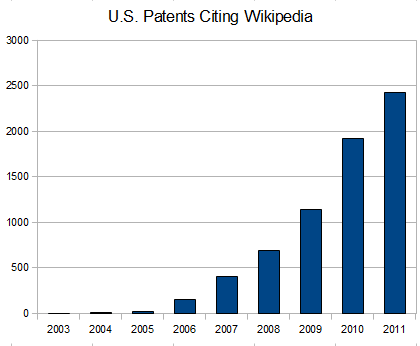
Wikipedia continues to be a favorite source of prior art references for inventors filing patent applications with the U.S. Patent and Trademark Office. The number of issued U.S. patents that cite Wikipedia articles increased by 26.3 percent in 2011, reaching an all-time high of 2,425. This is roughly one percent of all patents issued in 2011, a small but growing fraction. 

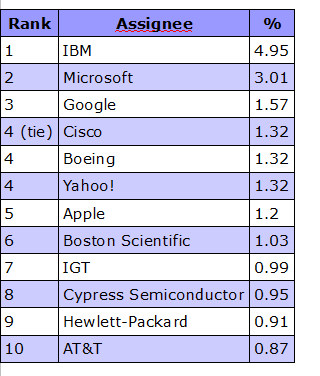
The top ten assignees shown in the table below hold approximately 17.65 percent of the 2011 patents that cite Wikipedia, which is off 5 percent from 2010. Once again, ICT firms dominated the top ten, which suggests that computer and telecommunications patents are more likely to cite Wikipedia than patents related to other technologies. The top three assignees (IBM, Microsoft and Google) account for nearly 10 percent of the total. Google jumped from 7th to 3rd place. Apple, which was in the top three last year, dropped to 5th place in 2011. Approximately 5 percent of the patents citing Wikipedia were unassigned, which is unchanged from 2010.

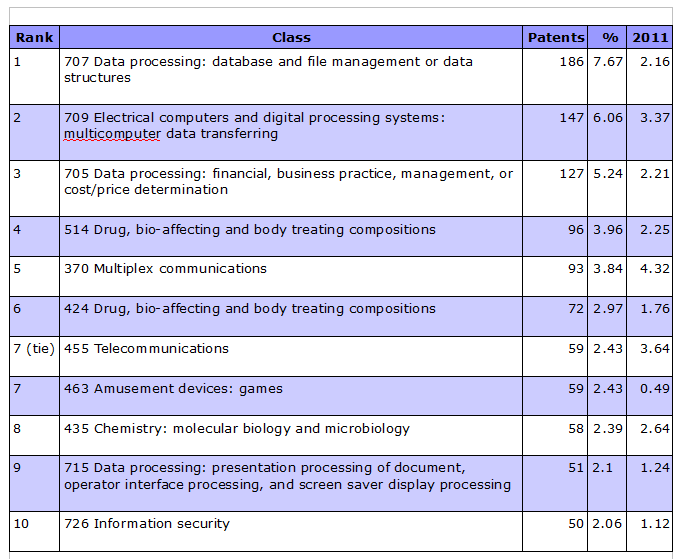
The second table below shows the top ten primary U.S. patent classes assigned to patents that cite Wikipedia. Unsurprisingly, the majority of the classes relate to information and communication technologies (ICT). However, four classes in the top ten, 514, 424, 435 and 463, cover technologies (pharmaceuticals and games) not directly related to ICT. In most cases, the percentage of patents in each class that cite Wikipedia exceeds the percentage of patents in that class. For example, Class 707 accounts for 7.67 percent of the patents that cite Wikipedia articles but only 2.16 percent of all patents issued in 2011.


Posted in Patent references, Prior art, Wikipedia | Leave a comment

USPTO Series Code 13

The USPTO is now using series code 13 for patent application serial numbers assigned from the end of 2010 forward. The first application in the series, 13/000,001, was published on May 26, 2011 (2011/0121738A1). Series code 12 was in use from December 2007 to early 2011.

Posted in Series codes, USPTO | Leave a comment

2011 U.S. Patent Statistics

In 2011 the USPTO issued 225,777 patents and published 321,181 applications for a total of 568,577 patent documents, a 1.5 percent decrease from 2010. The USPTO has published approximately 2.9 million utility and plant patent applications since March 15, 2001. Published applications now account for about 30 percent of all U.S. patent documents.

On August 16, 2011, the USPTO issued patent 8,000,000 to Second Sight Medical Products for a visual prosthesis apparatus. Patent 7,000,000 was issued on Feb. 14, 2006. The time interval between “millionth” patents has decreased to 5.5 years.

Table 1. Quarterly Patent Document Counts*
2011 ….. Patents (B) ….. PGPubs (A) ….. Total (A + B)
Q1 ….. 62,132 ….. 78,828 ….. 140,613
Q2 ….. 58,915 ….. 83,279 ….. 142,194
Q3 ….. 62,365 ….. 77,221 ….. 139,586
Q4 ….. 64,331 ….. 81,853 ….. 146,184

Table 2. Patent Number Ranges, Jan. 1 through Dec. 31, 2011*

Utility patents ….. 7,861,317 – 8,087,093 (225,777)
Reissues ….. RE42,020 – RE43,052 (1,033)
PGPubs ….. 2011/0000001 – 2011/0321,207 (321,181)
Designs ….. D629,996 – D651,375 (21,380)
Plants …… PP20,816 – PP22,427 (1,612)
SIRs ….. H2,251-H2,265 (15)

*Based on preliminary weekly data from the USPTO website. Number totals may change due to withdrawn patents and published applications.

Posted in Patent statistics, USPTO | Leave a comment