New USPTO Class Order: Classes 2, 57, 428

The USPTO has published Classification Order 1,854, dated February 7, 2006. The order affects subclasses in Class 2 – Apparel; Class 57 – Textiles: Spinning, Twisting, and Twining; and Class 428 – Stock Material or Misc. Articles.

Posted in Uncategorized | Leave a comment

U.S. Patent 7,000,000

Early this morning the USPTO issued utility patent no. 7,000,000. (A total of 3,920 other patents were also issued.)

The patent, which is assigned to DuPont, is for a new type of polysaccharide fiber and the process for making it. According to the abstract, the new fibers have “cotton-like properties” and are useful in textile applications. The inventor is John P. O’Brien, the recipient of several other patents for artificial fibers and methods of making them.

Of course, milestone patents are significant for more than just their numbers. With the recent furor over low-cost Chinese textile products flooding the U.S. after the expiration of the 30-year old international agreement on textiles in January 2005, this patent may be symbolic of the pressing need to invest in U.S. technological innovation and development. Despite textile industry and union appeals to “buy American”, American consumers are unlikely to pay top dollar for American-made underwear and golf shirts when they can buy similar goods at much lower prices on the world market. The U.S. economy needs technological innovation more than ever in order to compete in the global economy.

Critics of globalization often complain about the “race to the bottom”, i.e. that workers in industrialized countries will be forced to accept increasing pay cuts that make them more competitive with workers in developing countries like India and China. The answer to low-cost textile goods manfactured in China, India and other developing countries is not reducing the pay of American textile workers, it’s investing in technological innovation that produces new materials, products and markets. The future of the U.S. textile industry is not cheaper golf shirts produced in more efficient mills by lower paid workers, it’s technological innovation, research and development that leads to patentable inventions like Dupont’s polysaccharide fibers.

Posted in Uncategorized | Leave a comment

U.S. Patent 7,000,000 on Feb. 14?

If the USPTO issues 3,155 or more utility patents next Tuesday, Feb. 14, it is likely that they will include patent number 7,000,000. The UPSTO issued 3,040 utility patents on Feb. 7. The highest numbered utility patent is currently 6,996,845. Given the timing, one has to wonder what the subject of the milestone patent will be…

Perhaps a new formulation for fat-free chocolate? A method of identifying potential mates on-line? A recordable Valentine’s Day card with a built-in video display and speakers?

Patent No. 6,000,000 was granted on December 7, 1999 to inventors Jeff Hawkins and Michael Albanese. Their invention was a system for synchronizing files on two computers, the core technology of the Palm Pilot PDA, the first commercially successful hand-held electronic organizer. Other million-milestone patents include:

5,000,000 (March 19, 1991)
Ethanol production by Escherichia coli strains co-expressing Zymomonas PDC and ADH genes

4,000,000 (Decembre 28, 1976)
Process for recycling asphalt-aggregate compositions

3,000,000 (September 12, 1961)
Automatic reading system (barcodes)

2,000,000 (April 30, 1935)
Vehicle wheel construction

1,000,000 (August 8, 1911)
Vehicle tire

Posted in Uncategorized | 1 Comment

Chinese Universities Increase Patent Filings


There have been many articles and opinion pieces in American business and engineering magazines in recent months warning of the threat of China overtaking the U.S. in technical education and innovation. A recent issue of ASEE Prism, the magazine of the American Society for Engineering Education, concludes that China is in the process of creating world-class engineering universities. One of the keynote speakers at ASEE’s 2005 annual conference, Dwight Streit, VP of Foundation Technologies for Northrup-Grumman, warned that China is graduating some 325,000 new engineers per year compared to 70,000 in the U.S. A recent BusinessWeek article noted that Indian engineering firms are poised to capture more U.S. engineering and design work. It concludes that U.S. engineers need to be redeployed to higher-valued jobs.

Chinese universities are also making impressive progress in the realm of intellectual property. According to an article in the June issue of KnowledgeLink (Thomson Scientific), Chinese university patent activity is increasing at a faster rate than scholarly publications, a frequently cited measure of academic research output, because of intellectual property law reform and government policies encouraging domestic research and commercialziation. According to the 2004 annual report of China’s State Intellectual Property Office, Chinese universities and research institutes accounted for 17 percent of the approximately 111,000 new patent applications filed in 2004. Tsinghua University accounted for 875 new patent applications alone, followed by Shanghai Jiaotong University with 829 and Zhejiang University with 762. In comparison, the University of California (all campuses) filed 424 new patent applications with the USPTO in 2004, followed by Cal Tech with 135, and MIT with 132, in 2004. The World Intellectual Property Organization reported recently that Chinese PCT filings increased by 43.7 percent in 2005.

Posted in Uncategorized | Leave a comment

USPTO Keeps Fees in President’s 2007 Budget

President Bush’s budget proposal for fiscal year 2007 recommends that the U.S. Patent and Trademark Office keep all of the roughly $1.8 billion it collects in patent and trademark fees and supports additional increases for reducing application processing times and improving quality.

Inventors and intellectual property owners have long complained of Congress’s habit of diverting USPTO fees to fund other federal programs. Funding for the USPTO, an agency of the Department of Commerce, is covered in the bill authorizing the budgets of the Departments of Commerce, State and Justice. President Bush has supported ending the practice of diversion in recent budget proposals.

The USTO will need access to all its funds in order to decrease its increasing backlog of patent applications and support e-government initiatives. Last year the USPTO hired some 970 patent examiners and received more than 400,000 new patent applications. The USPTO expects to hire approximately 1,000 more examiners per year throught fiscal year 2011, according to testimony before Congress by Jon Dudas, Undersecretary of Commerce for Intellectual Property and Director of the USPTO. The number of pending patent applications could increase from approximately 600,000 today to 1,000,000 by 2010, according to Dudas.

The USPTO has a mixed record on implementing technological solutions to its workload problem. The USPTO’s award-winning Trademark Electronic Application System (TEAS), lauched in October, 1998 and its Trademark Electronic Search Search (TESS) have been very successful. More than 88 percent of new trademark applications are filed electronically, according to the USPTO’s 2005 annual report. TESS includes all registered and pending trademark applications and expired trademarks since 1984. The USPTO’s patent electronic filing system, EFS, despite significant investment, has not been successful. Less than 2 percent of new patent applications are filed electronically. Inventors and patent attorneys have complained of the system’s difficult user interface, complexity and reliability. According to the annual report, a new, web-based version of EFS should be in full production mode by the end of 2006.

According to a report in Federal Computer Week, the USPTO plans to use much of the fiscal year budget authority to hire more patent and trademark examiners, and improve examiner traininng. The report also stated that the USPTO would budget $70.2 million to improve its patent automation system and an additional $18.2 million to enhance its trademark automation system. $10.1 million will be allocated for improvements to the USPTO’s web-based information dissemination management system.

Posted in Uncategorized | Leave a comment

Japan, China, S. Korea Lead PCT Filings in 2005

The World Intellectual Property organization has reported a record 134,000 international patent application filings in 2005. China and the Republic of Korea were the countries with the largest increases in PCT filings, jumping to the 10th and 6th positions, respectively. Japan had the third largest growth in PCT filings. Together, the three Asian countries accounted for 24.1 precent of all international applications. In comparison, PCT filings from Canada numbered 2,315 and the United States 45,111.

Posted in Uncategorized | Leave a comment

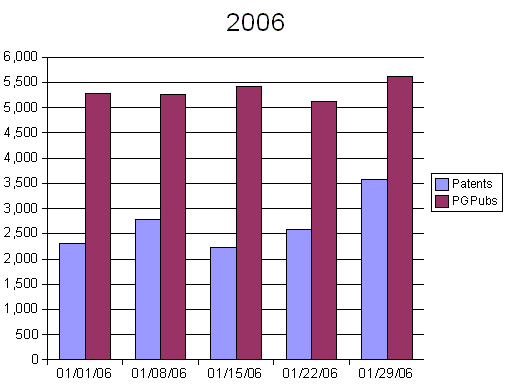
U.S. Patent Counts, Jan. 22-Feb. 2


The number of patents granted by the USPTO increased in the final week of January, jumping from about 2,500 on January 24 to 3,500 on January 31. This is one of only a few weeks since September 2005 that the USPTO has granted more than 3,000 patents in one week. Prior to October 1, 2005 the USPTO regularly granted 3,000-3,500 patents per week. The number of published applications increased slightly to 5,500.

Posted in Uncategorized | Leave a comment

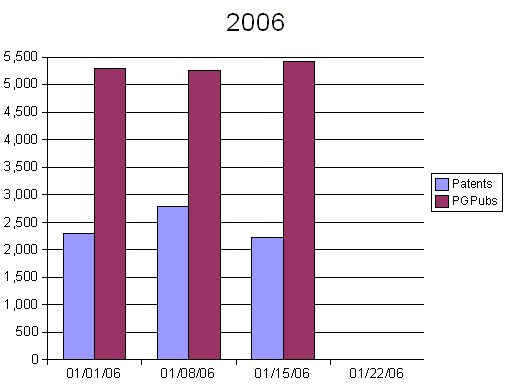
U.S. Patent Counts, Jan. 1-Jan 21

In the first three weeks of 2006 the USPTO published 15,973 applications and issued 7,315 patents. This is a drop of about 2,000 patents from the same period a year ago. The number of published applications in the first three weeks of 2005 was 15,830. Based on preliminary data from the USPTO web site.

Posted in Uncategorized | Leave a comment

Vatican to Publishers: Papal Writings Owed Royalties

According to a recent article in the London Times, the Vatican has implemented a new, strict copyright policy on the writings of Pope Benedict XVI and his predecessors going back fifty years. This includes the writings of John Paul II, John Paul I, Paul VI and John XXIII. Official copyrights on all papal documents will be assigned to the Vatican publishing house, the Libreria Editrice Vaticana. Publishers who wish to republish papal writings will be asked to pay a 3-5 percent copyright fee. Those who infringe papal copyrights face a 15 percent fee.

Vatican Cashes In by Putting Price on the Pope’s Copyright
, The Times, Jan. 23.

Posted in Uncategorized | Leave a comment

USPTO Warns Inventors About ID Theft

According to an article in the Washington Times on Jan. 20, the USPTO is warning inventors not to put sensitive information such as Social Security and bank account numbers on patent applications and related documents, lest it be used to commit identity fraud. Each week thousands of patent application files become available to the public on the USPTO web site. (Applications are published 18 months after the earliest filing date or when a patent issues.) The USPTO implemented a new policy on Oct. 1, 2005 by which it reserved the right to remove such information if inventors include it. An agency spokesman said that there were no known cases of inventor identity theft.

This is not the first time that the dissemination of patent information has been linked to potential inventor fraud. It’s interesting to note that in March 1874, just a few years after the Patent Office began publishing a weekly gazette containing abstracts (and inventor information) of newly issued patents, the Scientific American reported that inventors were receiving unsolicited letters from companies offering large sums to purchase their inventions provided they send a small sum ($5) to pay for an evaluation of their patent rights. Of course, few inventors received replies after sending in their money. Copies of the gazette were distributed to public libraries and private subscribers nationwide. Did this make it easier for unscrupulous patent agents and swindlers to contact potential victims?

Inventors Warned of ID Theft, Washington Times, Jan. 20, 2006
.

Posted in Uncategorized | Leave a comment