Academic Innovation Success Stories

Last year the Association of University Technology Managers (AUTM) launched the Better World Project to promote public understanding of how academic research and technology transfer benefits society and improves our way of life. AUTM has now released two publications highlighting academic innovations and a database of more than 100 products.

The Better World Report
Case studies on 25 innovations from academic research and technology transfer.

Reports from the Field
Profiles of 100 technology transfer success stories from Canada and the U.S. Innovations are grouped into 19 categories including biotechnology, environment, medical and nanotechnolgy. Also includes indexes by geographic location and institution. Unfortunately, Although many of the innovations are patented, no patent numbers are given. In most cases, however, it is easy to retrieve related patents from online databases using the information provided in a profile. (A good source of teaching examples?)

BWP DatabaseInnovations are searchable by field of application, institution, location or keyword. Again, no patent numbers are not included. (Perhaps a future improvement?)

Both reports are available for purchase or may be downloaded for free. The database is also provided free of charge. Lastly, a supplemental report on academic innovations from UK institutions is available.

Posted in Uncategorized | Leave a comment

Patent Information News 1/2006

The latest issue of the EPO’s Patent Information News (formerly EPIDOS News) is now available.

Articles include:

– Determining the value of a European patent
– IPC8 data in the EPO’s databases
– IPC reform and XML
– IPC reform – the user’s view
– OPS document delivery
– esp@cenet update

Posted in Uncategorized | 1 Comment

Searching Chinese and Japanese Designs

The European Patent Office has published two new guides on how to search Chinese and Japanese designs using Locarno classifications. Look for them under “Tips and Tricks for Searching Databases” in the EPO Far East FAQ – Japan and FAQ – China.

Posted in Uncategorized | Leave a comment

British Library Launches New "Business and IP Centre"

The British Library has launched a new service for innovators, entrepreneurs and business owners called the “Business and IP Centre” or BIPC. BIPC is built around the impressive patent and market research collections of the BL and offers free workshops, seminars, speakers, case studies and an e-newsletter.

Posted in Uncategorized | Leave a comment

New Archive Search Tool May Reveal Lost U.S. Patents

Librarians and historians know that researching early U.S. patents is often a frustrating exercise that ends in disappointment. Although the U.S. government registered approximately 10,000 patents from 1790 through 1836, almost all original U.S. patent documents and files from this period were lost in a devastating fire that swept through the Patent Office in the early morning hours of December 15, 1836. The Patent Office, using funds provided by Congress, attempted to rebuild its files by obtaining copies of patents from inventors. About 2,500 patents, the majority from the 1820s and 1830s, were recovered in this way. For the remainder, all that is known is the title, inventor name, and date. These patents are called “X” patents because of the unique serial number assigned to them many years later. Patent No. X1, the first U.S. patent, was granted to Samuel Hopkins on July 31, 1790. Copies of recovered X patents, many in handwritten script, are available in the USPTO web-based patent database.

Some experts believe that there are many more early U.S. patents waiting to be discovered in court archives, libraries, archives and attics. Indeed, over the years researchers and patent buffs have stumbled across several missing patents in archives and libraries. One of the largest caches was discovered in August 2004 when two New Hampshire patent attorneys located 14 lost patents in Dartmouth Library. A systematic search of courthouse archives and libraries would undoutably turn up more, but none has ever been undertaken (to my knowledge), probably because the cost would be prohibitive.

Fortunately, patent researchers now have access (until May 31) to a powerful new tool that may help them identify copies of lost pre-1836 U.S. patents located in archives, museums and libraries around the world. ArchiveGrid, an initiative of RLG, contains collection descriptions of nearly a million historical documents, personal papers and family histories from thousands of institutions. In effect, ArchiveGrid is a union catalogue of archival collections. RLG is seeking additional grants and sponsorships to keep the system free of charge.

A simple keyword search in ArchiveGrid discovered the following tantalizing patent documents, none of which appear in the USPTO database. (X patent number obtained from list of name and date patents, July 31, 1790 to July 2, 1836.)

Patent number: X3502
Merrow, Joseph M., 1848-1947.
Patent, gunpowder, 1822 April 19.
1 sheet ; 25 cm.
Notes and Summaries: Old Sturbridge VillageMStuO
Shelving control number: 1993.63 pc
Photocopy of “Letters patent” in making gunpowder, in names of Joseph M. Merrow and Robert McKee, Jr.See also Visual Resource Library for photo of Merrow Mill, and Manuscript Information File.McKee, Robert, Jr.RLG Union Catalog Record ID: MAOV93-A103

Patent Number: X5325
Mosher, Reuben.
Patent, 1829.
l item.
New York State Library
Manuscripts and Special Collections
New York State Library
Shelving location: Empire State Plaza, Albany, NY 12230.N
Shelving control number: 21208

Patent Number: X8725
Martin Rich patent, 1835. 1 item.
Patent issued to Martin Rich for an improvement in Iron Dogs for a Saw Mill called the Gauge Saw Mill Dog. Signed by Andrew Jackson, President of the United States, and dated March 27, 1835.Preferred Citation: Martin Rich Patent, #272m. Division of Rare and Manuscript Collections, Cornell University Library.Cornell University LibraryNICShelving control number: 272m.

Posted in Uncategorized | 1 Comment

U.S. Patent Counts, Jan. 1-Mar. 9, 2006


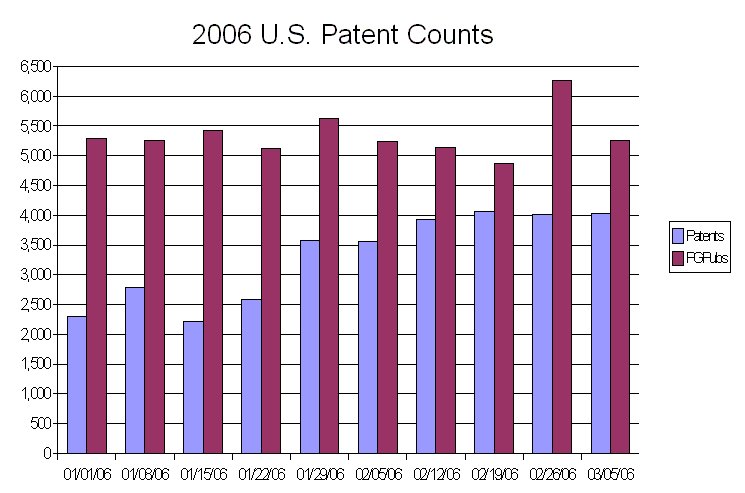
U.S. patent issues remained strong but stable in the second half of February and into the first week in March, perhaps signaling an end to four months of lower than anticipated patent grants.

The number of published applications jumped to more than 6,200 on March 2. The combined total of issued patents and published applications for the week of February 26 was more than 10,000.

Posted in Uncategorized | Leave a comment

2006 Patent Focus Report – Thomson KnowledgeLink


A little late but the Jan/Feb issue of Thomson’s KnowledgeLink newsletter has an interesting article highlighting the most important patent developments in China, Europe, India, Japan and the US.

A PROLIFIC YEAR IN PATENTING – 2006 PATENT FOCUS REPORT

Posted in Uncategorized | Leave a comment

DOE Launches Megasearch Initiative

According to a report in Federal Computer Week, the Energy Department’s Office of Science and Technology Information is launching a new “megaportal” initiative called Global Discovery that will allow users to retrieve scientific and technical information from four existing portals, “Science.gov, a portal with millions of pages of pre-publication research findings, a search engine for science conference proceedings and a database of international research on energy – by entering one query on one Web site.”

The USPTO patent database is one of many government sci-tech resources that can be searched via the Science.gov portal. Users may search it in tandem with other Science.gov resources or select just the USPTO database. However, the search engine is crude at best. While Science.gov retrieves keywords in patent titles with the same accuracy as the USPTO search engine–the title search “(pill or capsule) and (coating or film)” retrieves 10 patents. An identical search in the USPTO database retrieves the same 10 patents–it doesn’t find data in some fields, such as current classification, and has difficulty with inventor and assignee names. Search results are limited to 50 hits.

Science.gov searches only the USPTO patent database and not the published applications database, which contains ~1.2 million documents or roughly 15 percent of all US patent documents.

Posted in Uncategorized | Leave a comment

19th c. Patent Digests in Google Book Search


In December 2004, Google announced a partnership with four university libraries and the New York Public Library to scan and digitize millions of the books in their collections, many of them copyrighted. The goal of Google Book Search, as the project is called, is to make the full text of books owned by the world’s leading libraries and publishing houses available on-line within a decade.

While publishers and copyright owners have been successful in curbing Google’s efforts to scan works still protected by copyright, GBS is scanning older publications and materials not covered under copyright. This is a boon to researchers who want access to 19th and 20th century U.S. government documents, which are not copyrighted. For example, inventors, genealogists and historians can now access a few indexes and digest of patents published by the U.S. Patent Office in the mid-19th century. One example (bearing a Harvard Library bookplate) is:

A digest of patents issued by the United States including the years 1839, 1840, and 1841
to which is added the present laws relating to patents
Henry L. Ellsworth, Commissioner of Patents
Washington: William Greer, 1842

The digest list patents under the twelve classes of the U.S. patent classification system in alphabetical order by title. A separate section includes the text of patent laws up to August 1842.

As Google Book Search grows, more patent indexes and digests are sure to appear. In a short time it may be possible for anyone to browse by inventor name or subject the 19th century U.S. patent record. Of course, the USPTO web site already has a database of scanned images of U.S. patents back to 1790. However, patents prior to January 1976 can only be retrieved by patent number or current classification. Inventor name and title are not searchable. The presence of 19th century patent indexes in Google Book Search will make it easier for researchers to locate patents by inventor name, date and subject.

Posted in Uncategorized | 2 Comments

U.S. Patent Counts, Feb. 5-29


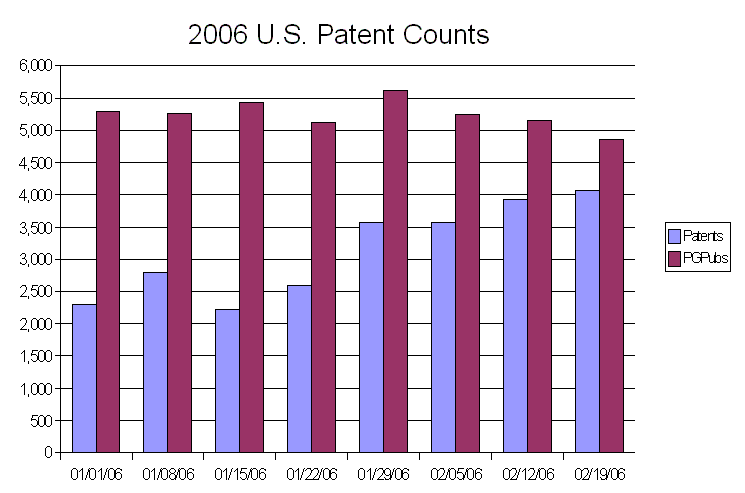
The number of issued patents continued to rise through the first three weeks in February, reaching a six-month high of 4,064 on February 21. A patent milestone was reached on February 14: the USPTO issued patent no. 7,000,000. The total number of patents issued in 2006 now stands at 25,032.

Published applications declined from 5,624 on February 2 to 4,862 on February 23. The total number of published applications in 2006 is 41,976, almost twice the number of patents.

Posted in Uncategorized | Leave a comment