DC Inventors Aim to be the Next Thomas Edison

Today’s (March 4) Washington Post reports on the people who turned out for a casting call for the PBS show “Everyday Edisons“. The first show in the series will air on April 28. Inventors mentioned include Frampton Ellis III (naturally contoured shoe), Daniel Davala (butter knife) and Matt Fleming (tabletop game). This month one hundred years ago, Thomas Edison received a patent on an electrical welding machine (847,746).

Posted in Uncategorized | Leave a comment

Maine State Tartan in Dispute

This story isn’t patent related but it’s interesting to me, since I’m from Maine..

Tartan centre of copyright lawsuit – L.L. Bean and copyright owner in fight over Maine State Tartan. The tartan was designed by a Canadian in 1964 and the copyright acquired by a private company in 1988.

Apparently, there are two Maine tartans… The Maine state legislature has proposed a Maine Dirigo Tartan that would be an alternative to the privately owned Maine State Tartan.

Posted in Uncategorized | 3 Comments

Canadian and U.S. Patent Maps


Several years ago I created a map of the U.S. showing the ratio of issued patents to population. I’ve recently updated it with 2006 statistics and created a second map for Canada. They’re simple maps based on the most recent data from the USPTO and Census Bureau, Canadian Intellectual Property Office and Statistics Canada.

U.S. Patent Map (2006)

The average for the U.S. is 32 patents per 100,000 population. The states with the highest rates are concentrated, as would be expected, in New England, the Pacific Northwest and West Coast. The states with the lowest rates are located in the Deep South, Appalachia, the northern prairies, Alaska, Hawaii and Puerto Rico.

Canadian Patent Map (2005)

Canada’s national average is only 4.52 patents per 100,000 population. It must be noted, however, that Canadian inventors file 3 times as many patent applications in the U.S. as they do at home. The lowest rates occur in the maritime provinces of Nova Scotia, New Brunswick, Prince Edward Isle and Newfoundland Labrador. Ontario and Quebec, where most of Canada’s manufacturing and high tech companies are located, score 4.72 and 4.47, respectively. The Yukon rate of 12.86 is due to its very small population.

Posted in Uncategorized | 1 Comment

New USPTO Class Orders

Two new classification orders are available on the USPTO web site. Order 1858, published last month, covers Class 348 – Television. Order 1859, published in February, affects Class 192 – Clutches and Power-Stop Control.

Interestingly, Order 1859 has a USPC-ECLA concordance section in addition to the standard USPC-IPC concordance. Could this be a sign that the USPTO is planning to use ECLA codes or is it part of the E-subclass Project started in 2002?

Posted in Uncategorized | Leave a comment

PatentMonkey Review


If a monkey typed at random on a keyboard, how long would it take it to write the complete patents of Thomas Edison? The infinite monkey theorem inspired the name of
PatentMonkey, the latest entrepreneurial start-up in an increasingly crowded field of patent searching and downloading services. It is owned by Invequity, a patent licensing company based in Reston, Virginia. The CEO and co-founder of PatentMonkey is Paul Ratcliffe, a registered patent attorney and former patent examiner.

PatentMonkey, like similar services, is supported in part by advertising and user fees. Users may search and view patents at no charge but must pay in order to download PDF copies of patent documents. Document download credits can be purchased in bundles of 20, 50 and 100; the price per download ranges from $.50 to $1.25. Users may also register for monthly or annual memberships that come with download credits, document management functions and fewer advertisments. Basic monthly membership has 50 downloads while basic annual membership offers 600 downloads. All membership packages offer fewer advertisements and the ability to create up to 100 folders for managing patent documents.

PatentMonkey includes only U.S. utility and reissue patents from August 1975 to the present, or about 3,200,000 utility patents and 10,800 reissue patents. According to the FAQ, published applications and design patents will be added in the near future. However, no mention is made of plant patents, defensive publications and statutory invention registrations. The absence of these miscellaneous patent documents, which number fewer than 25,000, might be excusable, but the lack of published applications (A docs) is a serious weakness. The USPTO has published 1.3 million patent applications since March 2001. About 15 percent of all U.S. patent documents are A docs. It appears that PatentMonkey is updated weekly.

PatentMonkey is a full text database with 29 searchable fields including patent number, date, title, abstract, claims, specification, current U.S. classification, international classification, inventor, assignee, etc. In comparison, the USPTO patent full-text and image database has 31 searchable fields. Test searches retrieved the same or very similar results compared to the USPTO database, discounting searches that retrieved design patents. (See the Patent Database Comparison Slides.)

All in all, PatentMonkey’s search functions and search results display are very similar to other services.
There are
five search modes: Quick, Quick+, Advanced, Patent Number and Bulk Patent Number. Quick mode searches terms in 1, 2 or 3 fields; Quick+ searches terms in up to 10 fields; advanced search is not yet available. Inventor and assignee searches use automatic left and right truncation. For example, a search on inventor lastname “Adler” also retrieves “Stadler” and “Sadler”. Curiously, left and right truncation and wildcards are not available for keyword searches. Phrase searching is possible using quotation marks.

Another weakness of the system is the lack of integrated U.S. patent classification (USPC) search tools. Users who want to do a classification-based search must first obtain their USPC classes and subclasses from another source, such the USPTO classification tools website. In comparison, the USPTO patent database and Manual of Classification, including schedules, definitions and index, have been integrated since at least 2000.

Figure 1. PatentMonkey Record with Patent Status Display.


PatentMonkey’s most useful feature is its patent status indicator. (See Figure 1.) Each retrieved patent record displays a status symbol indicating whether the patent is active, abandoned, abanoned less than 24 months (and eligible for reactivation), expired or status to be determined. The status is computed by a proprietary algorithm and does not take into account patent term extensions or adjustments. Users should
proceed with caution when evaluating status information.

With so many other free U.S. patent downloading services, such as Patent Lens, Pat2PDF and esp@cenet, it will be a challenge for PatentMonkey to find customers willing to pay $.50-$1.25 per patent. Its lack of design patents and published applications, limited truncation capabilities and classification search options are serious weaknesses. PatentMonkey’s patent status data is a useful feature not found in other databases, but it should be used in conjunction with the USPTO’s Public PAIR system.

Posted in Uncategorized | 19 Comments

Greatest Canadian Invention: Insulin

Last week the CBC aired the results of its “Greatest Canadian Invention” poll. The top three picks were:

1. Insulin (1921) – Banting and Best
2. Light bulb (1874) – Woodward and Evans
3. Telephone (1876) – Bell

Americans might be surprised to see the light bulb and telephone, two quintessentially “American” inventions, topping a list of Canadian innovations. But both have connections to Canada.

Alexander Graham Bell, inventor of the telephone, was born in Scotland and moved to Canada in 1870 at the age of 23. In 1872 he moved to Boston to take a teaching job and pursue his interest in telephony. He became a naturalized U.S. citizen in 1882 but spent most of his later life at his estate in Nova Scotia. He died and was buried there in 1922. In 1874 Thomas Edison bought the patent rights for a carbon filament light bulb from two Canadians, Henry Woodward and Mathew Evans, for $5000. His famous 1879 patent was an improvement on their design. The number 1 invention, insulin, was first isolated and produced in 1921 by Univ. of Toronto researchers Charles Best and Frederick Banting.

See http://www.cbc.ca/inventions/ for details about all 50 inventions in the poll, a teacher’s resource guide and numerous facts about inventing and patenting.

Some other quick facts about Canadian patents:

  • The first “Canadian” patent was granted in 1791 by the Legislature of Lower Canada to American inventor Samuel Hopkins.
  • Canada’s first federal patent statute was enacted in 1869. Canada’s first federal patent was issued on August 18, 1869.
  • Canadian inventors file more patent applications abroad (primarily in the U.S.) than at home. In 2005, Canadian inventors filed 5,102 patent applications in Canada and 8,309 applications in the U.S. They received 1,461 Canadian patents and 3,368 U.S. patents.
Posted in Uncategorized | Leave a comment

New Patent Caselaw Site

The guys over at phosita(R), an IP law blog, have just announced the release of fedcirc.us. According to their Jan. 2 posting, FedCirc is…

…”a website that allows patent professionals and other patent stakeholders to access, digest and manage patent caselaw information. The site is built on a foundation of timely, accurate, and considered reviews of patent decisions from the Supreme Court of the United States and the Court of Appeals for the Federal Circuit.”

Why did they do it?

“Three factors are coming together – now – to create an environment that begs for revolution: chaos in the law, an intense and sudden focus on patent law by non-patent professionals, and a technology tipping point that’s been exposed by the runaway success of patent blogs over the last several years.”

http://www.okpatents.com/phosita/archives/2007/01/a_little_something_new_fedcircus.html

Posted in Uncategorized | Leave a comment

U.S. Patent and PGPub Q4 Report and 2006 Review


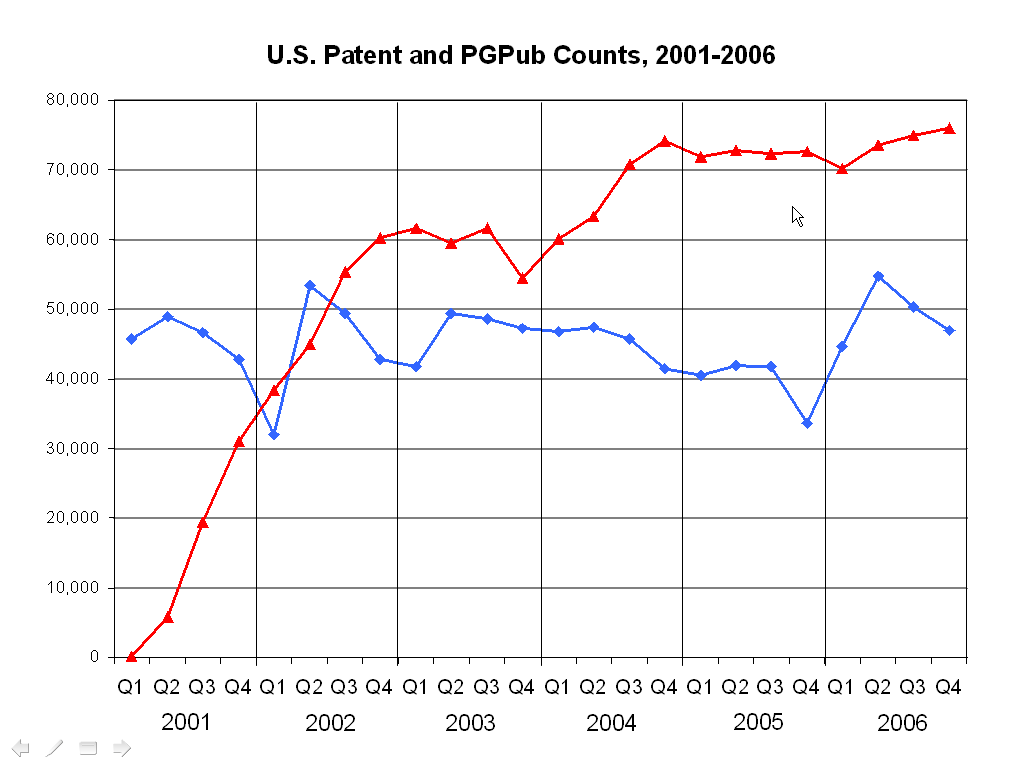
2006 was a record-breaking year for patents and pre-grant publications. In the final quarter of 2006 the USPTO published 76,032 applications, an increase of 1.49 percent over the previous quarter and a new record high. The total for the calendar year was 294,674, an increase of just 1.75 percent over 2005 but the highest annual total since the USPTO began publishing pending applications in 2001. Approximately 1.3 million applications have been published to date. Despite a slow start, 2006 was also a banner year for patents. The total for the year was 196,613, a whopping increase of 24.58 percent over 2005. The previous highest total (187,147) was set in 2003. The increase was due to very high outputs in Q2 and Q3. There was some slippage in Q4 with the USPTO issuing 46,912 patents, a decrease of 6.64 percent from the previous quarter. With the pending application backfile now over 1 million, the USPTO is expanding its workforce in order to deal with the increasing workload. According to the USPTO’s FY2006 annual report, the agency hired approximately 1,218 new patent examiners this year, bringing the total to 4,779. Current plans call for the USPTO to hire 1,200 examiners per year through 2011. 2006

Quarterly Patent and PGPub Counts*

Patents PGPubs Totals

Q1 44,699 70,147 114,846
Q2 54,749 73,593 128,342
Q3 50,253 74,902 125,155
Q4 46,912 76,032 122,944

196,613 294,674 491,287

*Based on weekly data from the USPTO’s PatFT and AppFT databases. Weekly totals may change after the fact due to withdrawn patents and published applications.

Average Weekly Totals for 2006

Patents 3,811
PGPubs 5,674


Number Ranges for 2006

Patents 6,981,282 – 7,155,745
Reissues RE38,928 – RE39,451

PGPubs 2006/0000001 – 2006/0294,631

Designs D513,356 – D534,0330

Plants PP16,176 – PP17,325

SIRs H2,137 – H2,176

Predictions for 2007

Series Code 12
Given the huge number of new applications in 2005 (410,000) and 2006 (443,000), it is likely that the USPTO will introduce series code 12 sometime in 2007. Series codes are two-digit numbers prefixed to application serial numbers. The USPTO assigns application serial numbers from 1-999,999. Series code 11 was introduced in December 2004.

Posted in Uncategorized | 3 Comments

WIPO PCT Glossary and History of PCT Regulations

The WIPO has released two new reference works for PCT users:

The PCT Glossary contains definitions for dozens of terms commonly used in PCT rules and documentation. Terms are linked to appropriate PCT articles, rules, administrative instructions and forms.

The History of PCT Regulations is a 300 page in-depth history of PCT rules from June 19, 1970-October 12, 2006. The first edition was published in 1995.

Posted in Uncategorized | Leave a comment

USPTO Receives 443,652 Patent Applications in 2006


Here are some interesting facts from the FY 2006 USPTO annual report:

# of new applications: 443,652 (up from 409,532 in FY05)
# of pending applications: 1,077,042 (up from 885,002 in FY05)
# of provisional applications: 121,307 (up from 111,753 in FY05)
# of issued patents: 183,187 (up from 165,483 in FY05)
Average pendency: 31.1 months (up from 29.1 in FY05)

Although the USPTO is hiring patent examiners like crazy (1,218 in 2006) , it can’t possibly train them fast enough to keep up with new filings *and* maintain quality *and* shorten review times. The number of published applications is going to continue to surpass issued patents 1.5-2.0 to 1. There will probably be more than 295,000 published applications in calendar year 2006 and perhaps 325,000 in 2007.

The bottom line: more outsourcing and fast-track examination programs.

Posted in Uncategorized | 1 Comment