New Classification Orders, #1867-1874

The USPTO has issued eight new classifications orders since Oct. 1, 2007, an unusually large number for a three-month period. Classes affected include:

711 – Electrical computers and digital processing systems: memory
714 – Error detection/correction and fault detection/recovery
715 – Data processing: presentation processing of document, operator interface processing, and screen saver display processing
506 – Combinatorial chemistry technology: method, library, apparatus
435 – Chemistry: molecular biology and microbiology
374 – Thermal measuring and testing
365 – Static information storage and retrieval
360 – Dynamic magnetic information storage or retrieval
318 – Electricity: motive power systems

Posted in classification orders, USPC | Leave a comment

Chinese Patent Databases, EPC 2000, etc.

The December issue of Patent Information News has several interesting and useful articles on free patent databases from China; the impact of the European Patent Convention (EPC 2000) on patent information searchers; and patent information from Asia.

Posted in EPO, Patent Information News | 1 Comment

USPTO Discontinues Another Paper Publication

According to a notice published in the Federal Register, the USPTO is discontinuing the paper version of its Patent and Trademark Office Notices effective December 25, 2007. The Notices, which are also published in the weekly Official Gazette, include announcements on USPTO policies, fees, mailing addresses and patent attorney registration. Other information related to patents includes expired patents, certificates of correction, withdrawn patents, maintenance fee notices, new reexamination proceedings and reissue applications. Notices will continue to appear in the electronic Official Gazette and the USPTO’s online archive, which contains notices from 1995 to the present.

In my opinion, this is a positive, if overdue change… Other patent offices long ago discontinued their print gazettes and notices. But it’s also a missed opportunity because the electronic version of the Notices is simply a facsimile of the print version. Why not integrate the post-allowance data published in the Notices (e.g. corrections, disclaimers, withdrawn numbers, expired patents) with other existing tools such as the PatFT database? It would be much more convenient and time saving to have access to this data in one place.

Posted in Notices, Official Gazette, USPTO | Leave a comment

Wikipedia References in Issued Patents

Back in September 2006 the USPTO banned patent examiners from using Wikipedia as a source of prior art information, citing its unreliability and lack of authority. Well, this apparently hasn’t stopped examiners or inventors from citing the popular online encyclopedia in patents. The number of Wikipedia articles cited in patents in 2007 jumped to 293, almost three times the number cited in 2006.

Of course, this pales in comparison to other sources of scientific and technical information. Patents that cited IEEE publications totaled 14,440 in 2007. There were also 3,268 citations to ACM publications and 972 to Chemical Abstracts. Heavily cited science and engineering publishers included Elsevier (2,106), McGraw-Hill (1,089), Springer (1,538) and Wiley (2,963). Online sources are increasing in popularity: websites were cited in 10,870 patents issued in 2007.

Posted in in, Prior art, Wikipedia | 3 Comments

U.S. Patent and PGPub Year-End Review


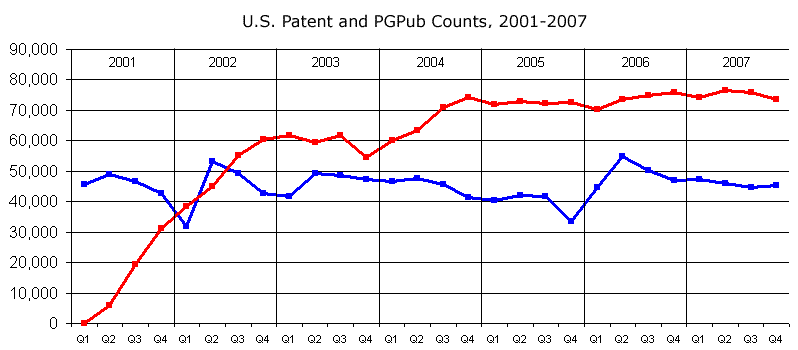
2007 was a bit of a mixed bag for U.S. patents and published applications. In Q4 the USPTO published 73,450 applications, the lowest number in more than a year and a 3 percent drop from the same quarter in 2006. However, the total number of PGPubs for the calendar year was 300,198, a 1.87 percent increase over 2006. This is the first year that PGPubs have exceeded the 300,000 mark. Approximately 1.6 million applications have been published since 2001. The USPTO issued 45,401 patents in Q4, a 3 percent decline from the same period in 2006. The total number of patents issued in 2007 dropped to 183,128, which is 13,485 or 6.86 percent fewer than 2006. Weekly issues and PGpubs were relatively stable with few peaks or canyons. (See Table 2.) According the the USPTO’s FY2007 annual report released in November, inventors set another record for new filings, submitting 467,243 applications, a 4.85 percent increase over 2006. In order to deal with this continuing growth the USPTO hired another 1,215 examiners in FY2007, bringing the total patent examining corps to 5,477. Despite the additional staff the backlog of pending patent applications grew to 1,112,517, a 10.82 percent increase over FY2006.

Table 1. Quarterly Patent and PGPub Counts*

Quarter ….. Patents ….. PGPubs ….. Totals
Q1 ….. 47,332 ….. 74,277 ….. 121,609

Q2 ….. 45,828 ….. 76,640 ….. 122,468

Q3 ….. 44,567 ….. 75,831 ….. 120,398

Q4 ….. 45,401 ….. 73,450 ….. 118,851

2007 ….. 183,128 ….. 300,198 ….. 483,326

*Based on weekly data from the USPTO’s PatFT and AppFT databases. Weekly totals may change after the fact due to withdrawn patents and published applications.

Table 2. Weekly Averages and Medians for 2007

Patents ….. 3,515 ….. 3,539
PGPubs ….. 5,762 ….. 5,659

Table 3. Number Ranges for 2007

Patents ….. 7,155,746 – 7,313,828
Reissues ….. RE39,452 – RE39,963

PGPubs ….. 2007/0000001 – 2007/0300346

Designs ….. D534,332 – D558,425

Plants ….. PP17,326 – PP18,372

SIRs ….. H2,177 – H2,207

Table 4. Withdrawn Patent and PGPub Numbers in 2007

Patents ….. 831
PGPubs ….. 143

Predictions for 2008

Last year I predicted that the USPTO would adopt series code 12 for utility and plant patent applications before the end of 2007. We won’t know for sure for a few months, but the USPTO is on track to run out of serial numbers for series 11 before the end of the year. Recently published applications filed in September have serial numbers in the 850,000-855,000 range. Applications are published 18 months from the earliest priority filing date (provisional or foreign), which means that many new applications are published 6 months (or less) after filing. So it looks like series 12 will be appearing on or about Jan. 1. Series code 11 was adopted on Dec. 1, 2004.

Posted in Patent statistics, USPTO | 1 Comment

Canadians Too Lazy to Invent?


A recent op-ed in the Globe and Mail (Dec. 27) uses patent statistics to make the case that Canada, in general, and the province of Alberta, specifically, needs to focus more on math, science and the creative arts in schools in order to ensure future prosperity. The writer argues that since Canada is about one-tenth the size of the U.S., Canadian inventors should have been granted 240,000 U.S. patents over the last twenty years. Instead, they have received only 77,594.

Although I agree that Canada needs to do more to cultivate innovation rather than rely on natural resources for economic growth, I’m generally skeptical about such comparisons. In fact, I believe that patent statistics show that Canadians are among the most inventive, creative people in the world.

Let’s take a broader look at patenting trends among the G8 countries over the last few years. With just over 33 million people, Canada is the smallest country in the G8, yet since 2000 Canadian inventors have been granted nearly as many U.S. patents as their counterparts in France and Great Britain, which have populations almost twice as large. In terms of the per capita number of patents issued, Canada, with about 1000 people per patent, ranks second after Japan (488:1) and Germany (857:1) and well ahead of France (1702:1), Italy (3458:1) and Russia (60991:1).

A much more interesting statistic, in my opinion, is the fact that Canadian residents apply for and receive far fewer patents in Canada than the U.S. In 2006, Canadian inventors filed 10,243 U.S. patent applications and were granted 3,743 patents, but filed only 5,348 Canadian patent applications and received 1,495 patents. Obviously, this might be explained by the fact that Canadian inventors believe they can get more bang for their buck in the U.S., where the consumer and venture capital markets are much larger.

Table 1. G8 Patenting Trends, 2000-2007*

Country / Pop. / U.S. Patents

Canada / 33,390,141 / 34,702
France / 60,876,136 / 35,765
Germany / 82,400,996 / 96,102
Italy / 58,147,733 / 16,814
Japan / 127,433,494 / 289,628
Russia / 141,377,752 / 2,318
United Kingdom / 60,776,238 / 38,579
United States / 300,000,000 / 668,807

*Based on data from USPTO patent databases and annual reports.

Posted in Canada, Patent statistics | 1 Comment

E-Documents as Prior Art


Wynn Coggins, director for the USPTO’s Group 3620 (Electronic Commerce), has written an article called “When is an Electronic Document a Printed Publication for Prior Art Purposes?

Posted in electronic documents, Prior art | Leave a comment

New Report: Patents per 100K Workers, 2001-2006

The State Science and Technology Institute (SSTI), a nonprofit organization that supports economic development through science, technology and innovation, has released a new report showing the ranking in number of patents issued per 100,000 workers for U.S. states and the District of Columbia from 2001-2006.

West coast states improved the most over the five-year period with Washington and Oregon ranked #1 and #2 and California at #4. In the farm belt, Kansas (#4) and Oklahoma (#7) showed strong growth, as did Massachusetts (#3) and Rhode Island (#6) in New England, which has been a hub of innovation for 150 years. Minnesota, Georgia and Colorado rounded out the top ten. Surprisingly, Idaho, which ranked #1 in all five years, had the fouth largest decline (-18.7), dropping from 328.2 patents per 100K workers in 2001 to 266.8 per worker in 2006. Idaho is in no danger of losing its #1 rank anytime soon, thanks to Boise-based Micron Technology, Inc., one of the top-ten patenting companies in the U.S. The Gem State’s two closest competitors, California and Vermont mustered only 161.5 and 160.3 patents per worker in 2006.

Patents Per 100K Workers
% Change 2001-2006

1. Washington 46%
2. Oregon 36.8
3. Massachusetts 14.1
4. Kansas 13.4
5. California 12.9
6. Rhode Island 11
7. Oklahoma 7.7
8. Minnesota 6.3
9. Georgia 6.2
10. Colorado 5.9

Posted in economic development, Patent statistics | Leave a comment

EPO Survey: esp@cenet Exporting Function

The EPO is conducting a survey on a proposed improvement to esp@cenet scheduled for 2008. Specifically, they’re asking for feedback on the usefulness of exporting data in CSV or XML formats.

Currently, the only patent office database (that I’m aware of) that supports exporting is the German PTO’s DEPATISnet. You can download bib data in an Excel spreadsheet from up to 250 records at a time.

This is a wonderful development.
At my university a number of engineering and business students take entrepreneurship courses that require them to use patent data to identify key companies/innovators, develop market profiles and analyze long-term industry trends. Being able to export data from esp@cenet would save them a lot of time. In my opinion, CSV is more useful than XML, especially for users such as students and private inventors who are not familiar with XML, since it can be easily imported into a spreadsheet for analysis.

If you’re an esp@cenet user and would like to provide feedback, go to the esp@cenet forum at http://forum.espacenet.com/ and look in the Information Channel. You will need to register in order to submit comments and vote.

Posted in espacenet, exporting data | Leave a comment

Dutch Six-Year Patent Will End in 2008

The Netherlands Patent Office has announced that it will phase out its six-year patent (C1 document) in 2008. The six-year patent is a weaker form of patent protection than the standard 20-year patent. An application for a six-year patent is automatically registered without a novelty search or examination 18 months after filing. According to the agency’s latest annual report, 602 6-year patents and 1,771 20-year patents were granted in 2005. Of all patents granted, over 50 percent went to private inventors and companies of 1-200 employees.

Posted in Netherlands, Petty patent | Leave a comment