U.S. Patent Counts, Q1 2008

The USPTO published a record-breaking 77,962 patent applications (A docs) in Q1, an 11 percent increase over the same quarter last year. This was a strong rebound from the 73,450 A docs published in Q4 2007. Approximately 1.7 million plant and utilty patent applications have been published since 2001.

The USPTO’s new emphasis on quality over quantity appears to be working. Issued patents (utility, plant, design and reissue) declined 8 percent from last year, dropping to 43,657, the lowest count in more than two years. The number of statutory invention registrations (SIRs) also continued to decline; only four were registered in Q1. SIRs are a form of defensive publication that was established in 1985. Their purpose was diminished somewhat when the USPTO began publishing applications in March 2001.

There’s still no sign that the USPTO has implemented series code 12 for incoming patent applications. The most recent A docs filed in early December 2007 have serial numbers in the 950,000s, suggesting that the current series has enough numbers to last through the end of the year. It’s possible that the USPTO may start the new series on January 1, which was the practice for many decades. The 10th series began on October 24, 2001 and the 11th series on December 1, 2004.

Table 1. Quaterly Patent and PGPub Counts*

Qn ….. Patents …..PGPubs ….. Total
Q1 ….. 43,657 ….. 77,962 ….. 121,619

*Based on preliminary weekly data from the USPTO website. Totals may change after the fact due to withdrawn patents and published applications.

Table 2. Weekly Averages and Medians (Q1)

Patents ….. 3,406 ….. 3,755
PGPubs ….. 5,997 ….. 5,965

Table 3. Number Ranges for 2008 (Counts)

Patents ….. 7,313,829 – 7,350,238 (36,260)
Reissues ….. RE39,964 – RE40,189 (226)
PGPubs ….. 2008/0000001 – 2007/0078005 (77,962)
Designs ….. D558,426 – D565,275 (6,843)
Plants ….. PP18,373 – PP18,671 (299)
SIRs ….. H2,208 – H2,211 (4)
Posted in Patent statistics, USPTO | Leave a comment

Paris Convention and Public Access to Patents

This year is the 125th anniversary of signing of the Paris Convention for the Protection of Industrial Property, one of the cornerstones of the modern international industrial property system. The treaty was signed in Paris by representatives of 11 countries on March 20, 1883. Today, there are 172 member countries.

The convention introduced many important principals to international intellectual property law. First and foremost, it required members to apply the same level of protection to nationals of other member countries as their own citizens. It also established the right of priority, a grace period for the payment of maintenance fees, and the right of the inventor to be mentioned in a patent. Less well know is its impact on the dissemination of patent information.

Article 12, which has the rather ambiguous title “Special National Industrial Property Services” requires member states to make intellectual property information available to the public. Specifically, the text of the Article states:

(1) Each country of the Union undertakes to establish a special industrial property service and a central office for the communication to the public of patents, utility models, industrial designs, and trademarks.

(2) This service shall publish an official periodical journal. It shall publish regularly:
(a) the names of the proprietors of patents granted, with a brief designation of the inventions patented;
(b) the reproductions of registered trademarks.

It’s easy today to take for granted free and reliable access to patent information. Would it have been so if the framers of the Paris Convention had not valued the importance of information dissemination? Would the public enjoy the level of access to patent, trademark and design information it has today? Probably not.

Posted in paris convention, patent information dissemination, WIPO | Leave a comment

Review: Japanese-English Chemical Dictionary

Japanese-English Chemical Dictionary: Including a Guide to Japanese Patents and Scientific Literature. Edited by Markus Gewehr. Wiley-VCH, 2007. 680 p. $230 ISBN 978-3527312931

My library just received a copy of this very impressive reference work. The bulk of the book consists of a dictionary of more than 60,000 Japanese scientific and technical terms. I don’t read Japanese, but it appears very comprehensive and useful to anyone attempting to read Japanese patents and journal articles. The first part of the book consists of a half dozen chapters. Chapter 1 is an overview of the Japanese language. Chapter 2 describes the characteristics of Japanese scientific and technical publications. Chapter 3 covers naming chemical compounds. Chapters 4 and 5 focus on Japanese patent documentation and patent law. For me, these were the most interesting and useful sections. Chapter 4, Patent Documentation, was written by the editor, Markus Gewehr, and Irene Schellner of the Japanese Patent Information unit in the European Patent Office. This chapter has a tremendous amount of detailed information about the history and evolution of Japanese patent documents, search systems and numbering systems. Numerous tables provide details about kind codes, INID codes, headlines, etc. There’s also a good overview of the Japanese special classification systems known as the File Index (FI) and File Forming Terms (F-terms).

Posted in Japan, JPO, patent documents, patent numbers | Leave a comment

USPTO Class Order 1876 – Class 73: Measuring and Testing

The USPTO has published Classification Order #1876 affecting Class 73, Measuring and Testing. This is the generic class for processes and apparatus for making measurements or tests of any kind. New mainline headings in the class include:

112.01 Turbine engine
113.01 Steam or water operated engine; related engine system or engine component
114.01 Internal combustion engine or related engine system or engine component
115.01 Vehicle drive train
116.01 Test stand
117.01 Vehicle chassis
118.01 Simulating operating condition

Posted in classification orders, USPTO | Leave a comment

Spark-IP: Patent Search Tool


High-quality patent databases are so commonplace on the web these days it’s hard to get excited about yet another offering. Sure… there’s always room for improvement, but how many patent databases does the world really need? Apparently, it does.

Spark-IP was launched last October as an “eBay” for intellectual property owners to advertise their inventions and technologies available for licensing. The beta site is currently freely available for anyone to use, but some services and advanced functions will eventually be priced. The site is open to listings from universities, corporations and government agencies, but soon anyone will be able to post a technology for a fee.

At the heart of Spark-IP is a searchable database containing four million U.S. patents and published applications. This data is augmented by technology listings submitted by registered users. Users can search by keyword in title, abstract, full text, or claims; inventor, assignee and patent number.

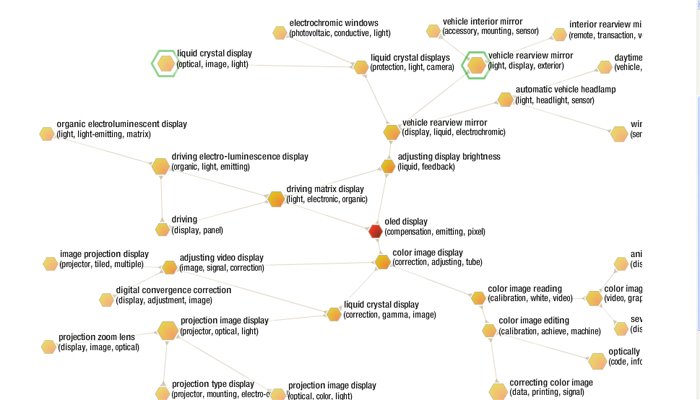
What’s interesting about Spark*IP is that it presents search results as technology landscape maps called SparkClusters. These maps are constructed by algorithms that group related patents and technology listings into discrete groups. There are about 40,000 Sparkclusters now, but this will change as new technologies emerge and evolve. Another type of map is the SparkCluster Neighborhoods, which display the total population of a landscape cluster, rather than just the technology retrieved in by a keyword search.

Figure 1. A SparkCluster map for OLED technology. The darker the colour of the cluster, the greater its cumulative keyword strength. Green halos around a cluster indicates indicate the presence of one or more technology listings.

Posted in Graphical Tools, Patent databases, SparkIP | 1 Comment

Tupperware Patents


The U.S. economy may be sputtering, consumer confidence is tanking, and food and energy prices are at all-time highs. But there’s one company that sees a silver lining in all this gloomy news. Tupperware, the 62-year old company famous for its plastic food storage products, knows that when times are bad, it’s sales go up. People still have to eat, after all, and they need a safe way to store their leftovers.

Earl S. Tupper (1907-1983), the company’s founder and namesake, had patented several small inventions (comb case, shoe heel) before he found success in plastic containers. On October 5, 1946 he filed four design patent applications for a sugar bowl (D156855), pitcher (D154348) and pitcher covers (D158155 and D156854), which were issued between 1949-1950. A year later, a paint can lid inspired him to design an air-tight container for food. In 1954, Tupper received his first patent for container specifically designed for food (2695645).

Tupperware has received thousands of patents (mostly design patents) on food storage, preparation and serving products. In 1969, Tupperware was sold to Rexall Drugs, which later became Dart Industries. All Tupperware patents since the early 1970s have been assigned to Dart. Both Tupperware and Dart are now based in Orlando, Florida.

Posted in design patents, trademarks, Tupperware | 3 Comments

In Search of the Perfect Battery

The Economist has published an excellent article on the history of automotive battery technology. It notes that electric cars were common in the first decade of the 20th century until the invention of the electric starter in 1912 made internal combustion engines, which provided better range and power, the dominant technology.

In August 2005, the USPTO established a new cross-reference class for hybrid electric vehicles (Class 903). There are now some 1,579 patents and 1,127 published applications classified under Class 903. Cross-reference classes are intended to provide supplemental information and are never assigned as primary classifications.

A number of famous inventors tried their hand at perfecting electric automobiles. One of the earliest patents (No. 594,805) for an electric car was issued in 1897 to Hiram Maxim, inventor of the Maxim machine-gun. Thomas Edison also attempted to develop (with limited success) improved batteries for the automotive industry.

Posted in Electric cars, Hiram Maxim, Thomas Edison | Leave a comment

New Classification Order – Class PLT

The USPTO has issued a new classification order (#1875) affecting Class PLT (Plants). The order establishes about 100 new subclasses under a new main heading called “Herbaceous Ornamental Flowering Plant (Nicotina, Masturtium, etc.)”.

Posted in classification orders, plant patents | Leave a comment

PCT Filings Set New Record in 2007

2007 was another record-breaking year for international patent application filings, according to a recent press release by the World Intellectual Propety Organization. A total of 156,100 applications were filed last year, a 4.7 percent increase from the year before. The country with the most filings was the U.S., which accounted for 33.5 percent of new filings, followed by Japan with 17.8 percent and Germany with 11.6 percent. The Republic of Korea (#4) and China (#7) had the largest increases among the top ten countries. Canada (#12) accounted for 1.9 percent.

Posted in Uncategorized | Leave a comment

USPTO Patent Manual Archive

The USPTO has made available all editions and revisions of the Manual of Patent Examining Procedure (MPEP) back to 1948. The original (un-numbered) edition of 1948, the Manual of Patent Office Procedure, included extensive material previously published by the Patent Office Society. The 1st edition followed in 1949. The 8th edition was published in 2001 and has been revised five times, mostly recently in August 2006. This collection is a great resource for practicing patent attorneys, patent law scholars and patent searchers in need of historical information. The MPEP is the responsibility of the Deputy Commissioner for Patent Examination Policy.

Posted in Uncategorized | Leave a comment