When I teach people how to conduct a proper search of the patent literature, I always find it challenging to convince them that they need to include older patents in their searches. Most people, especially undergraduate students, are content to do keyword searches that will retrieve only patents from the mid-1970s forward. They seem to believe that older patents couldn’t possibly be relevant to whatever technology they’re interested in. Of course, this is not the case: there are many technologies that can trace their origins back to the mid-19th century (or even earlier).

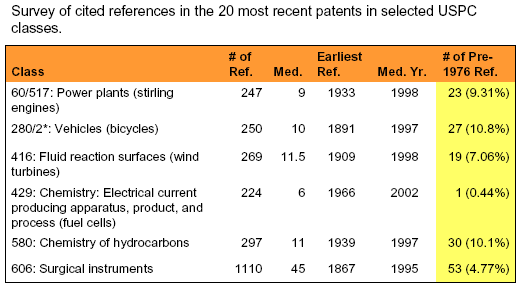
I decided recently that I needed some hard data to back up my arguments, so I looked at the cited references in recently issued patents in selected USPC classes and subclasses. References are cited by applicants and patent examiners based on their relevance to the patented invention. Of course, this includes patents back to 1790. For this exercise I chose bicycles (280/2*), stirling engines (60/517), wind turbines (Class 416), fuel cells (Class 429), hydrocarbons (Class 580) and surgical instruments (Class 606). I retrieved the 20 most recent patents in each class/subclass and compiled the references to US patents in a spreadsheet. The results were very interesting.

In four of the five classes/subclasses, the total number of references ranged from 247 to 297; the median number of references ranged from 6 in fuel cells (Class 429) to 11.5 in wind turbines (Class 416). Surgical instruments (Class 606) had 1110 references, almost four times the average in the other four categories, with a median of 45 references per patent. The earliest references ranged from 1867 in surgical instruments to 1966 in fuel cells. Fuel cells had the fewest pre-1976 references (1 or 0.44 percent). But approximately 10 percent of the references in stirling engines, hydrocarbons and bicycles were earlier than 1976. Surgical instruments had 5 percent and wind turbines had 7 percent.

This data illustrates the importance of pre-1976 patents in the technological record and makes a strong argument for searching by patent classification. With the exception of fuel cells, all categories had a substantial number of references prior to 1976 which would not be retrieved by keyword searches.
Posted in classification, Patent references | 1 Comment

Pringles Aren’t Potato Chips

A UK judge has decided that Pringles aren’t potato chips, which could save Procter & Gamble millions in taxes every year. The judge based his decision in part on the fact that the chip-like snack is only 42 percent potato. The UK doesn’t apply sales tax to most foods, but potato chips and other snack-like products are taxed.

Pringles were invented more than forty years ago by Alexander Liepa, a food scientist at Cincinnati-based P&G. Liepa received a patent (3396036) on August 6, 1968 for a “potato food product” made from a dough consisting of 21-46 percent potato solids, 1-15 percent milk solids and 53-73 percent water. He later patented additional improvements to the formula (3998975) and the design of a machine for molding the dough into the product’s trademark concave shape (3608474). (Also see trademark application 75207172.)

Happy 40th birthday, Pringles!

Posted in Pringles, snack foods | Leave a comment

Happy Independence Day!

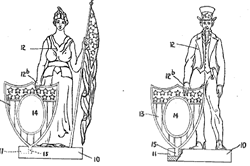
A few patriotic patents for your enjoyment on the 4th of July. The first is a jack-in-the-box featuring a rather creepy-looking Uncle Sam (US978489); next are matching picture frames with Lady Liberty and Uncle Sam–a perfect gift for queen and king who have everything! (US1283100); the third is a bottle shaped like Uncle Sam holding what appears to be a rifle–for taking shots at squirrels and evil doers?! (USD29331); and, finally, two flags inspired by the design of the US flag. It’s surprising how many patent flag designs there are based on Old Glory. See USPC D11/167 and D11/168.


Posted in design patents, Independence Day, Uncle Sam | Leave a comment

Peer to Patent Review Program Update

The USPTO has announced the results of its year-long patent review pilot program called Peer to Patent. The purpose of the program, which was launched in June 2007, was to evaluate the feasibility and effectiveness of an online-based system where registered experts could submit prior art related to pending patent applications. The pilot program was limited to 250 applications in the computer technologies. According to the USPTO, the program recruited 2,000 experts who submitted 173 pieces of prior art related to 40 applications. Patent examiners used the prior art to reject 12 applications, about five percent of the applications in the system.

It’s interesting to note that the USPTO’s current backlog of unexamined applications is about 750,000. Given the size of the backlog and the record-breaking levels of new filings (467,000 in 2007), it’s difficult if not impossible to imagine how Peer to Patent might have any significant impact on the examination process or patent pendency.

In the 1970s the USPTO launched a similar program (but without the technology) called the Trial Voluntary Protest Program. Under TVPP, the public was invited to submit prior art on two thousand selected applications. Only a handful of prior art submissions were received and only a few applications rejected. The USPTO concluded that the program was ineffective and decided not to pursue it.

Posted in Patent peer review | Leave a comment

Happy Canada Day!

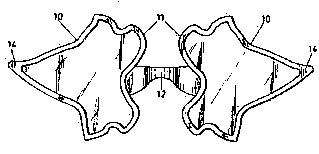
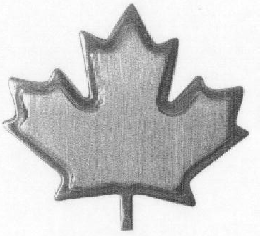
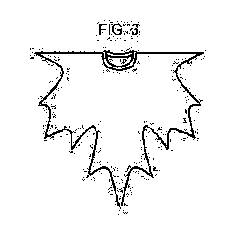
In honour of Canada Day, here are a few Canadian industrial designs that are based on the maple leaf, the national symbol of Canada. All were retrieved from the CIPO’s industrial design database, which includes designs registered from1861 to the present. Unfortunately, CIPO doesn’t classify designs by shape, so the only way to retrieve specific designs is by keyword searching in the title or description field. The designs include a sun visor (71471), sunglasses (24929), poncho (106525), pin (100394) and glove (109475).


Posted in Uncategorized | Leave a comment

New Book: Mr. Gatling’s Terrible Marvel

This is library conference season, so I’ve been racking up frequently flyer miles by the thousands. Air travel isn’t as fun for me as it was pre 9/11, but spending hours in the air does give me an opportunity to catch up on my reading. On my most recent flight I finished Mr. Gatling’s Terrible Marvel: The Gun that Changed Everything and the Misunderstood Genius who Invented It by Pulitzer Prize-winning writer Julia Keller. The book is a biography of Dr. Richard Jordan Gatling and his most famous invention, the Gatling Gun, the first practical machine gun. (See the Economist review, “A Little Gatling Music.”)

Strangely enough, Gatling claimed to have invented his machine gun in order to mitigate the pain and suffering caused by war. His reasoning, so he claimed, was that a rapid-firing weapon would require much fewer soldiers, thus reducing the size of armies and the number of battlefield casualties. Keller does a good job of capturing the essence of life in 19th century America, with all its energy, contradictions, noise and (even) odors. Central to her story is the idea that the U.S. patent system made it possible for amateurs like Gatling to drive economic development and social change farther and faster than ever before.

The book contains several factual errors and omissions. For example, Keller states that Samuel Hopkins, the first American inventor to be granted a patent under the new federal patent law in 1790, was from Pittsfield, Vermont. In fact, Hopkins was born in Maryland to Quaker parents and was a resident of Philadelphia for most of his life. (Journal of the Patent and Trademark Office, March 1998) And Although Keller mentions Gatling’s many other patented inventions (his first successful invention was a seed planter patented in 1844), she provides the patent numbers for only a few: Nos. 3,581, 36,836 and 47,631). According to a Wikipedia article, Gatling’s lifetime total was nearly 50 patents. It’s interesting to note that searching Gatling’s name in Google Patents retrieves only 12 patents.

Posted in 19th century patents, Richard Gatling | Leave a comment

New Patent PDF Download Tool

Patent Retriever is a new service for downloading patent documents. Launched just days ago (May 30), it will retrieve US, EP and WO (PCT) patent documents in PDF format fairly quickly, although I haven’t timed it against other similar services. Users may download single documents or up to ten documents in batch download mode. It appears to retrieve some US documents from the EPO’s esp@cenet database and some from the USPTO website. However, it does not appear to retrieve pre-1836 patents (X patents) or additional improvement patents.

Posted in patent documents, Patent Retriever | 1 Comment

Helvetica

Last night I watched a very interesting documentary by Gary Hustwit called Helvetica. It was a fascinating conversation with graphic designers about the font Helvetica, typography and graphic design. Helvetica was created in 1957 by Max Miedinger and Eduard Hoffmann at the Haas type foundry in Munchenstein, Switzerland and within a decade became the world’s most successful and well-known font.

The story reminded me that the first U.S. design patent, issued in November 1842, was for a type font. Unfortunately, the surviving copy is a handwritten document that does not include drawings of the font. (See D1.)

The inventor (or designer) was George Bruce, a Scottish immigrant and owner of a type foundry in New York. Bruce was one of the most successful type designers in the 19th century. His inventions included numerous fonts and improvements to type-casting machines.

Since 1842 there have been thousands of design patents for fonts. Fonts are classified in the USPC under Class D18, Printing and Office Machinery, subclasses D18/24-D18/33. It’s interesting to note that Bruce’s first patented font is still being cited in recent design patents.

Posted in design patents, fonts, George Bruce | Leave a comment

Classification Order 1877 – Class 606, Surgery

The USPTO has recently published Classification Order #1877 affecting subclasses in Class 606, Surgery. Class 606 is part of a mega-class composed of Classes 128, 600, 601, 602, 604, 606, 607. Class 606 covers surgical instruments. This is the third classification order issued this year. As of June 1, 2008, approximately 38,000 patents (1790-present) and 21,000 published applications (2001-present) are classified in Class 606.

Posted in classification, classification orders, USPC | Leave a comment

New Patent PDF Download Tool

IP Newsflash (IPN), an information portal for IP news, official notices and case law, has added a patent document download to its suite of patent information tools. Users can retrieve a PDF copy of any patent document in the EPO’s Open Patent Services (OPS) database by entering a patent or publication number. Other tools include a patent family search (with data export in XLS, DOC and XML formats), prior art search and register of EPO Board of Appeals decisions. IPN also tracks recently granted EP patents and published applications up to six months old through its EP Monitor service. Users can view graphs and lists of top applicants by IPC.

IPN is one of my favorite sites for tracking IP news. Its suite of information tools is an excellent compliment to official patent office websites.

Posted in patent documents, patent information dissemination | 5 Comments