Searching the USPC: Proximate Function


For novice patent searchers one of the most difficult concepts in the U.S. Patent Classification system is the idea that inventions can be classified on the basis of “proximate function.” Proximate function is one of four schemes in the USPC used to classify subject matter disclosed in patents and published applications. The other three are “industry or use,” “effect or product” and “structure.” The rationalie behind proximate function is that “similar processes or structures that achieve similar results by the application of similar laws of nature to similar substances are considered to have the same fundamental utility and are grouped together.” (See the Handbook of Classifiction.) For example, a refrigeration system used to cool beer and a refrigeration system that cools milk are treated the same under the USPC.

The patents of A.C. Gilbert, inventor of the Erector Set, offer another example of proximate function at work. Gilbert’s inspiration for the Erector set was real-life construction sites he saw around his home in New Haven, Connecticut. Many of his patented inventions are simply scaled-down versions of construction materials such as beams, girders, brackets, trusses and rivets. Consequently, you can find Gilbert’s patents classfied under both Class 446, Amusement Devices: Toys, and Class 52, Static Structures (Buildings). Because of the concept of proximiate function a search for patents for construction toys should include the appropriate subclasses from both classes. A third search possibility is the design class D21, Games, Toys and Sports Goods; subclasses 484-505 specifically relate to construction-type toys.
Posted in A.C. Gilbert, Erector Set, proximate function, USPC | Leave a comment

A.C. Gilbert – Inventor of the Erector Set and the "man who saved Christmas"

The other day when I was channel surfing I happened across a movie called The Man Who Saved Christmas, starring Jason Alexander as Alfred C. Gilbert, the inventor of the Erector set, one of the classic American toys of the 20th century. Gilbert became known as the “man who saved Christmas” during World War I when the U.S. government was considering a ban on the production of toys in order to support the war effort. Gilbert appeared before the Council of National Defense and successfully argued against the ban.

Gilbert was a Yale graduate and amateur magician who started with his partner John A. Petrie a business for producing magic tricks and apparatus. The company was named the Mysto Manufacturing Co. and based in New Haven, Conn. On Dec. 5, 1911, Petrie patented a disappearing cigarette trick (US1010794) and assigned the rights to Mysto. Gilbert’s interest, however, soon turned away from magic and to construction toys. On Jan. 20, 1913, he applied for a patent for toy construction blocks. The application described toy building blocks made of strips of sheet metal and the means of fastening them together with u-shaped couplings. The patent issued on July 8, 1913 (US1066809), the first of more than 150 patents Gilbert would receive for Erector set components and other toys. The A.C. Gilbert company (Gilbert changed the name in 1917) continued to produce Erector sets , train sets and other toys into the 1960s.

Whatever happened to Gilbert’s partner John Petrie? He parted ways with Gilbert in 1913 shortly after the introduction of the Erector set. He continued to invent and in 1917 patented an lighted hand mirror (US1216724) and a sand-wheel toy (US1247145). The trail grows murky after that. A John W. Petrie, also of New Haven, Conn. (possibly a son?), received several patents from the 1920s through 1940s for toys, magic devices and other items. Many of these were assigned to the Petrie-Lewis Manufacturing Co.

Posted in A.C. Gilbert, Erector Set, Toys | Leave a comment

EPO Adds Latin American Patents


The EPO has added patent data from Cost Rica (CR), Peru (PE) and El Salvador (SV) to esp@cenet and some of its other patent data products. In addition, data from Cuba (CU) which had not been updated from 1996, will be re-introduced in the database at the end of December.

The actually number of patent documents added is small: 51 for Cost Rica (Mar-Aug, 2007), 110 for Cuba (Jan 2007-Apr 2008), 616 for El Salvador (2004-2007) and 94 for Peru (2004-2007).

Posted in Costa Rica, Cuba, El Salvador, Latipat, Peru | Leave a comment

Patented in China: New Report from Thomson Reuters

Thomson Reuters has published a new report called “Patented in China: the Present and Future State of Innovation in China.” Patent filings from China have been growing faster than any other region in the last few years and if the trend continues it will become the “dominant country in the patent landscape” by 2012. The press release and PDF report are available at http://scientific.thomsonreuters.com/press/2008/8494659/.

The EPO’s East Asian Patent Information portal has a number of FAQs and guides to Chinese, Korean and Japanese patents.

Posted in China, economic development, Patent databases | Leave a comment

FreePatentsOnline Increases Personal Portfolios to 10,000 Documents

Individual accounts on FreePatentsOnline now can contain up to 20 portfolios and up to 10,000 patent documents. Users are still limited to exporting bibiliographic data from a maximum of 250 documents at a time. These improvements will be useful for searchers who maintain large collections of patent documents or who run multiple patent searches. Thanks, FPO!

Posted in FreePatentsOnline, Patent databases | Leave a comment

Snow Bike Hits Slopes

Skiers and snowboarders may see something different on the slopes this winter… Two entrepreneurs from Vancouver Island hope to launch the next winter sports craze with their snow bike, a winter version of a mountain bike. Called the Ktrak, the bike is equipped with a ski in the place of the front wheel and a rubber track around the back wheel. Kyle Reeves, the inventor of the bike, has applied for patents in the US and Canada. He received a US patent on the rear drive assembly in 2007 (US7232130) and has a pending Canadian application (CA2497365A1) . Another pending CA application is for the front ski (CA2496740A1).

Posted in Canada, inventors, Ktrak, Snow Bike | Leave a comment

Betty James, Wife of Slinky Inventor Arnold James , Dies at 90

Betty James, wife of Richard James, the naval engineer who invented the world-famous Slinky spring toy in 1945, has passed away at the age of 90. Her obit is in the New York Times. Mrs. James named the toy ‘Slinky’. The Slinky is one of the great toy invention success stories of the 20th century. In December 1945 Richard sold the first 400 Slinkys at Gimbels in Philadelphia in 90 minutes. Since then more 300 million Slinkys have been sold worldwide. Mrs. James took over as president of the business in 1960 when her husband abandoned the family and moved to Bolivia to join a religious cult. She served as president until 1998.

The patent (US2415012) on the Slinky is an excellent example of how vague patent descriptions can be. The title of the patent is ‘Toy and Process of Use’. The text describes the Slinky as a ‘helical spring toy,’ referring to its coil-like shape. The name Slinky does not appear at all, since the original application was filed on November 1, 1945, probably before Mrs. James had selected the name. Patent Office rules discourage inventors from including trademarks and product names in the applications. For such a simply object, the patent has a surprising number of very detailed claims, 19 in total. The specification includes the dimensions of the original design and a detailed discussion of the mechanics of springs. It would be a useful teaching example for first-year engineering students.

Posted in Arnold James, Betty James, Slinky, Toys | 2 Comments

Happy Thanksgiving!

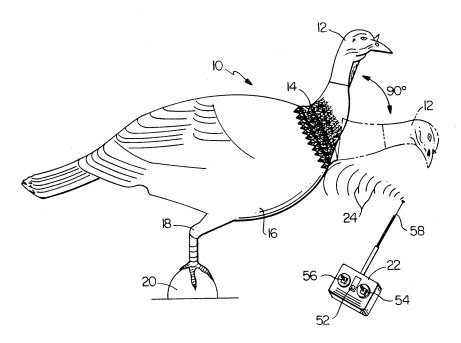
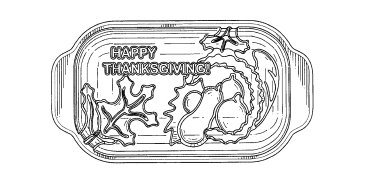
Tomorrow is Thanksgiving in the States and in a few hours millions of Americans will be sitting down to a traditional turkey dinner. In honour of that noble and self-sacrificing bird, here are a few turkey-related patents. Of course, few people today actually hunt and kill their own turkey. But for those that do, there is this patented animated turkey decoy, US5289654, for luring reluctant gobblers into the open. If you prefer to have your bird and eat it too, there is this turkey trophy mounting kit, US5064725, for displaying the tail fan, beard and feet and an eye-catching “full strut” turkey plaque, USD566614. This attractive turkey figurine, USD314357, is the perfect center piece for any Thanksgiving table. And don’t forget to bast your turkey using this turkey-shaped baster, USD390070.


Happy Thanksgiving!
(USD527217)

Posted in Thanksgiving, turkeys | 1 Comment

Canada Dry Ginger Ale at 100

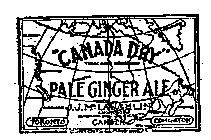
A little over one hundred years ago, John James McLaughlin, a Toronto pharmacist, created one of the world’s most famous carbonated beverages, Canada Dry Pale Ginger Ale, the “champagne of ginger ales.” McLaughlin started in 1890 manufacturing soda water and eventually decided to create a beverage with a little more pizazz. He experimented with more than 100 different formulas until he perfected his sparkling beverage in 1907. McLaughlin also invented and patented several machines for bottling his popular beverage. These include an apparatus for dispensing carbonated liquids (US736000 and CA83850) and a bottle washing machine (CA88234). He also acquired the rights to at least one patent for siphon filler (US678502). Canada Dry is now owned by Cadbury Beverages.

Posted in Canada Dry, John James McLaughlin | Leave a comment

Patents and Biotech – a Broken System? Fixed by Information

A couple of months ago a Montreal-based non-profit IP consulting firm called The Innovation Partnership issued an interesting report calling for changes in the way biotechnology IP is created, disseminated and protected. In recent years there has been much debate in academic and research circles about whether the prolific patenting and licensing of biotechnology IP inhibits pure research and information sharing. The full report is available at:

Toward a New Era of Intellectual Property: From Confrontation to Negotiation – A Report from the International Expert Group on Biotechnology, Innovation and Intellectual Property

What struck me most about the report was the number of recommendations linked to the dissemination of patent information to the public. Specifically, the authors of the report argue that… “As custodians of the patent system, patent offices around the world should…

… build publicly-available databases of patent information that can be used to better track the impact and effectiveness of not only the IP system, but of particular methods of dissemination.

… should collect patent-related information in a standard form and make this available to the public for free. Data should include information that will assist in assessing patent landscapes in targeted areas of technology, such as essential medicines. Patent databases should be linked so that a user can identify not only the patents in one country but related patents in other countries. These databases should also be easily searchable.

…should collect data on the type and major terms of licence agreements. A pilot project at the Japanese Patent Office on creating such a database should be expanded and spread to patent offices around the world.

…To better enable patent offices to respond to the needs of the public sector, these offices
should establish policy branches that would investigate ways to make data more available, assist in patent landscaping and disseminate information about the patent system.

Posted in Biotechnology, Patent databases, patent information dissemination | Leave a comment